

The phrase “try new things” means experiencing, learning, doing, or exploring something you have not done before. It can refer to activities, foods, hobbies, travel, skills, ideas, or personal experiences.
People often use it when talking about personal growth, adventure, creativity, learning, or making life more interesting. For example, someone might encourage a friend to try a new hobby or suggest that a coworker explore a different approach to a project.
However, repeating “try new things” can make your writing sound predictable. Using a more specific alternative can make your message clearer and better match the situation.
Why Use Other Ways to Say “Try New Things”?

Different alternatives can communicate slightly different ideas. Some focus on adventure, while others emphasize personal growth, experimentation, or openness.
Using varied wording can help you:
- Avoid repeating the same phrase.
- Make your writing sound more natural.
- Match casual and professional situations.
- Express encouragement more effectively.
- Add a specific meaning or emotion.
- Make your writing more engaging.
10 Best Other Ways to Say “Try New Things”

1. Try Something Different
Meaning
“Try something different” is one of the closest and most natural alternatives to “try new things.” It suggests changing your usual routine or choosing an option that is unfamiliar or different from what you normally do.
Best For
- Casual
- Friendly
- Warm
- Polite
Example 1
If you’re tired of the same restaurants, let’s try something different this weekend.
Example 2
You could try something different with your morning routine and see what works.
Quick Tip
Use this phrase when you want a simple replacement that sounds natural in everyday American English.
2. Explore New Experiences
Meaning
“Explore new experiences” emphasizes discovering activities or situations you have not experienced before. It has a positive, curious tone and works especially well when discussing travel, hobbies, learning, or personal development.
Best For
- Professional
- Formal
- Friendly
- Warm
Example 1
Traveling alone gave Maria a chance to explore new experiences and become more independent.
Example 2
College is a great time to explore new experiences and discover what interests you.
Quick Tip
Choose this phrase when you want to highlight discovery rather than simply doing something unfamiliar.
3. Step Outside Your Comfort Zone
Meaning
“Step outside your comfort zone” means doing something that feels unfamiliar, challenging, or slightly uncomfortable. The phrase often connects new experiences with confidence, courage, and personal growth.
Best For
- Professional
- Friendly
- Warm
Example 1
Speaking at the conference helped James step outside his comfort zone.
Example 2
If you want to grow as a photographer, step outside your comfort zone and experiment with new subjects.
Quick Tip
Use this expression when the new activity requires courage or involves overcoming hesitation.
4. Branch Out
Meaning
“Branch out” means exploring options beyond what you normally choose or do. It is especially useful when someone has a narrow routine and wants to discover different interests, methods, or opportunities.
Best For
- Casual
- Friendly
- Professional
Example 1
I’ve always cooked Italian food, but I’m ready to branch out and learn some Thai recipes.
Example 2
The designer decided to branch out into motion graphics.
Quick Tip
“Branch out” is particularly natural when talking about hobbies, careers, food, skills, or creative interests.
5. Embrace New Experiences
Meaning
“Embrace new experiences” suggests being willing and positive about unfamiliar opportunities. Compared with “try new things,” it sounds more intentional and optimistic.
Best For
- Formal
- Professional
- Warm
- Friendly
Example 1
Moving to a new city encouraged her to embrace new experiences.
Example 2
Successful teams often embrace new experiences instead of relying only on familiar methods.
Quick Tip
Use this phrase when you want to encourage an open-minded attitude rather than simply suggest an activity.
6. Experiment With Something New
Meaning
“Experiment with something new” focuses on testing an unfamiliar idea, method, style, or activity. It suggests curiosity and a willingness to learn from the result.
Best For
- Professional
- Casual
- Friendly
Example 1
Try to experiment with something new when you’re developing your next design concept.
Example 2
I decided to experiment with something new by making homemade pasta.
Quick Tip
This is a strong choice when the activity involves creativity, problem-solving, cooking, design, or other hands-on work.
7. Venture Into Unfamiliar Territory
Meaning
“Venture into unfamiliar territory” describes entering an area, activity, or situation that is new to you. It has a more expressive tone and can suggest curiosity, challenge, or adventure.
Best For
- Formal
- Professional
- Warm
Example 1
The company decided to venture into unfamiliar territory by developing educational software.
Example 2
Writing fiction allowed the journalist to venture into unfamiliar territory.
Quick Tip
Use this phrase when the new experience feels significant or challenging rather than ordinary.
8. Seek New Experiences
Meaning
“Seek new experiences” means actively looking for opportunities to learn, explore, or experience something unfamiliar. It sounds purposeful and is often associated with curiosity and personal development.
Best For
- Formal
- Professional
- Warm
Example 1
After graduation, she wanted to seek new experiences before choosing a career path.
Example 2
People who seek new experiences often discover interests they never expected.
Quick Tip
Choose this phrase when you want to emphasize actively searching for opportunities rather than casually accepting them.
9. Be Open to New Possibilities
Meaning
“Be open to new possibilities” focuses on having a flexible and receptive mindset. It does not necessarily mean immediately doing something new; instead, it encourages considering unfamiliar options.
Best For
- Professional
- Formal
- Friendly
- Warm
Example 1
Keep an open mind and be open to new possibilities during your job search.
Example 2
The team needs to be open to new possibilities if it wants to solve the problem creatively.
Quick Tip
Use this alternative when you are discussing ideas, opportunities, decisions, or future possibilities rather than physical activities.
10. Broaden Your Horizons
Meaning
“Broaden your horizons” means expanding your knowledge, interests, experiences, or understanding of the world. It suggests that new experiences can help you see different perspectives.
Best For
- Formal
- Professional
- Warm
- Friendly
Example 1
Studying abroad can broaden your horizons and introduce you to different cultures.
Example 2
Reading books from different cultures is an easy way to broaden your horizons.
Quick Tip
This phrase works especially well when discussing education, travel, culture, personal development, or learning.
Comparison Table

| Alternative | Best Used In | Tone |
| Try something different | Everyday conversations | Casual, Friendly |
| Explore new experiences | Travel, hobbies, personal growth | Warm, Positive |
| Step outside your comfort zone | Challenges and self-development | Encouraging |
| Branch out | Hobbies, careers, interests | Casual, Professional |
| Embrace new experiences | Personal or professional growth | Positive, Warm |
| Experiment with something new | Creative or practical activities | Curious, Practical |
| Venture into unfamiliar territory | Major challenges or new fields | Formal, Expressive |
| Seek new experiences | Personal development and opportunities | Purposeful |
| Be open to new possibilities | Ideas, decisions, and opportunities | Professional, Positive |
| Broaden your horizons | Education, culture, and travel | Reflective, Formal |
Common Mistakes
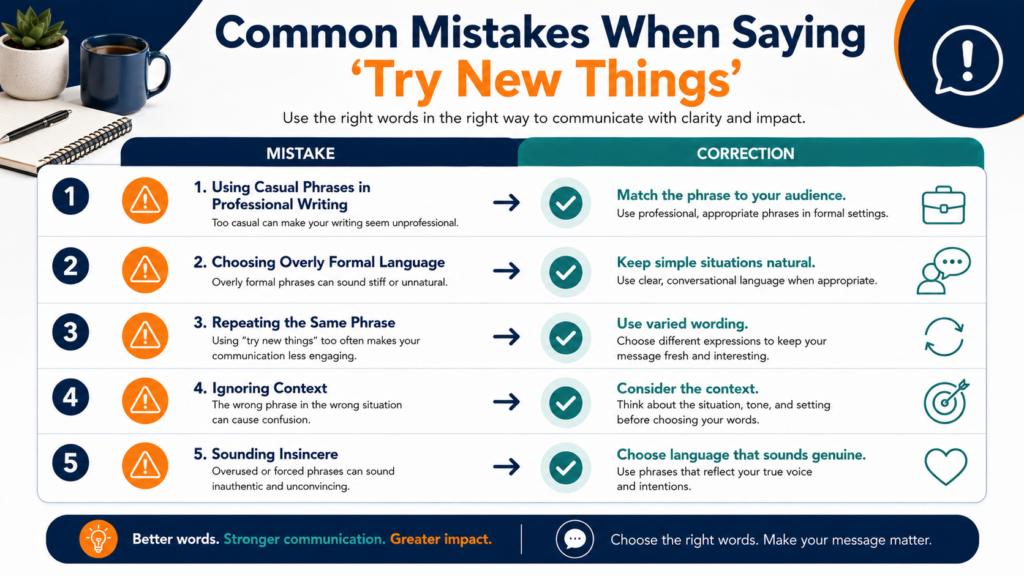
1. Using Casual Phrases in Professional Writing
Phrases such as “try something different” can work in professional communication, but they may sound too informal in a formal report. Consider “explore new approaches” or “be open to new possibilities” when appropriate.
2. Choosing Overly Formal Language
Not every situation needs sophisticated wording. Saying “venture into unfamiliar territory” to describe trying a new sandwich may sound unnecessarily dramatic.
3. Repeating the Same Phrase
Using “try new things” several times in the same paragraph can make your writing feel repetitive. Replace it with a context-specific alternative when the meaning remains accurate.
4. Forgetting the Context
Not every alternative has exactly the same meaning. “Step outside your comfort zone” suggests a challenge, while “be open to new possibilities” focuses more on mindset.
5. Sounding Insincere
Choose wording that fits your natural voice. If you are writing a friendly message, overly formal language can make a simple suggestion feel distant or forced.
Frequently Asked Questions
What is the best way to say “try new things”?
The best alternative depends on your context. “Try something different” is the closest everyday option, while “explore new experiences” sounds more polished. If you mean personal growth, “step outside your comfort zone” is often stronger because it suggests facing unfamiliar or challenging situations.
What is another word for trying new things?
There is no single perfect replacement, but words such as exploring, experimenting, discovering, branching out, and venturing can express the idea. The best choice depends on what you are doing. For example, “experimenting” works well for testing ideas, while “exploring” works well for experiences or interests.
How do you say “try new things” professionally?
For professional writing, consider phrases such as “explore new approaches,” “embrace new experiences,” “be open to new possibilities,” or “experiment with new ideas.” These options can sound more polished while still communicating curiosity, flexibility, and willingness to learn.
What is a casual way to say “try new things”?
A natural casual alternative is “try something different.” You can also say “branch out” when encouraging someone to move beyond their normal choices. For example, “You always order the same thing—why not branch out and try something different?”
Is “step outside your comfort zone” the same as “try new things”?
They are similar, but they are not identical. “Try new things” can describe any unfamiliar activity, even one that feels easy. “Step outside your comfort zone” usually implies doing something that feels challenging, unfamiliar, or slightly uncomfortable.
What phrase means trying different experiences?
“Explore new experiences” is one of the clearest choices. It suggests discovering activities, places, interests, or situations that you have not experienced before. “Seek new experiences” is another good option when you want to emphasize actively looking for those opportunities.
How can I say “try new things” in an encouraging way?
Try “step outside your comfort zone,” “embrace new experiences,” or “broaden your horizons.” These phrases can make your message feel more motivating because they connect new experiences with confidence, discovery, learning, or personal growth.
What is the difference between “branch out” and “broaden your horizons”?
“Branch out” usually means expanding into different activities, interests, methods, or areas. “Broaden your horizons” has a wider meaning and often refers to expanding your knowledge, perspective, or understanding. Both can encourage someone to move beyond familiar experiences.
Conclusion
Finding another way to say “try new things” can make your writing more precise, natural, and engaging. The right alternative depends on what you want to communicate and who will read it.
For everyday conversations, “try something different” is simple and natural. If you are talking about hobbies or interests, “branch out” works well. For personal growth, “step outside your comfort zone” adds a stronger sense of challenge. In professional or educational writing, “explore new experiences,” “be open to new possibilities,” and “broaden your horizons” can sound more polished.
The key is not to replace the phrase just for variety. Choose an expression that matches your exact meaning, tone, and situation. That small change can make your American English sound much more natural.