

When writing an essay, book report, article, or research paper, you may need another way to say “the author says.” Repeating the same phrase can make your writing sound dull and predictable.
Fortunately, English offers many natural alternatives. Some words show that the author is explaining information, while others indicate that the author is making an argument, sharing an opinion, or drawing attention to an important point.
What Does “Another Way to Say the Author Says” Mean?

“Another way to say the author says” means finding different phrases to introduce or attribute an author’s ideas, statements, opinions, or arguments.
Writers commonly use these alternatives in essays, academic papers, book reviews, reading responses, and literary analysis. Using a more precise reporting verb can also help readers understand the author’s purpose.
For example, an author may state a fact, argue a position, explain an idea, or suggest a possibility. Choosing the right word makes your writing clearer.
Why Use Other Ways to Say “The Author Says”?

Using alternatives to “the author says” can make your writing more interesting and precise. Instead of repeating one phrase, you can choose a verb that better describes what the author is actually doing.
Using different alternatives can help you:
- Avoid repetitive writing.
- Make your sentences sound more natural.
- Show the author’s purpose more clearly.
- Improve academic and professional writing.
- Create stronger transitions between ideas.
- Match the tone of your essay or analysis.
The key is to choose a word that accurately reflects the author’s message.
10 Best Other Ways to Say “The Author Says
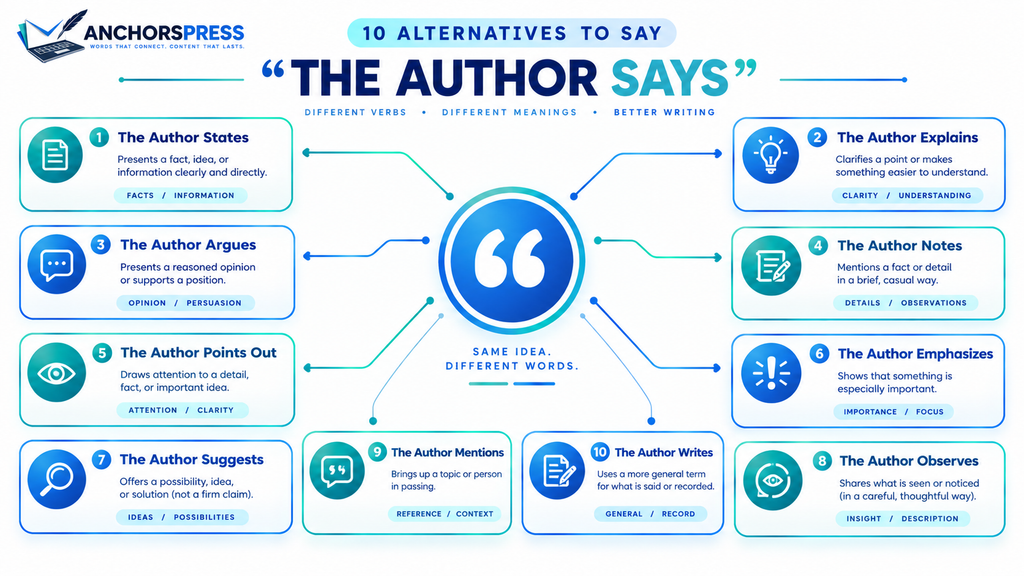
1. The Author States
Meaning
“The author states” means that the author clearly presents information, a fact, or a position. It is one of the most common alternatives in formal and academic writing.
Best For
Professional, Formal, Polite
Example 1
The author states that regular exercise can improve both physical and mental health.
Example 2
In the opening chapter, the author states that education should be available to everyone.
Quick Tip
Use “states” when the author gives information clearly and directly.
2. The Author Explains
Meaning
“The author explains” shows that the writer is helping readers understand an idea, process, or situation. It works especially well when the original text provides details or background information.
Best For
Professional, Formal, Friendly
Example 1
The author explains how the invention changed communication across the country.
Example 2
The author explains why the main character decides to leave her hometown.
Quick Tip
Choose “explains” when the author breaks down an idea or provides useful details.
3. The Author Argues
Meaning
“The author argues” means that the author presents a claim and supports it with reasons or evidence. This phrase is common in persuasive and analytical writing.
Best For
Professional, Formal
Example 1
The author argues that public transportation deserves greater investment.
Example 2
Throughout the article, the author argues that social media can influence public opinion.
Quick Tip
Use “argues” when the author is trying to convince readers of a particular position.
4. The Author Suggests
Meaning
“The author suggests” is useful when the author presents an idea, possibility, or indirect opinion. The author may not be making a strong claim but is encouraging readers to consider something.
Best For
Professional, Formal, Polite
Example 1
The author suggests that small changes can lead to better study habits.
Example 2
The author suggests that the character’s silence may represent fear.
Quick Tip
Use “suggests” when an idea is implied rather than directly stated.
5. The Author Notes
Meaning
“The author notes” means that the author points out or briefly mentions an important detail. It often introduces information that supports a larger discussion.
Best For
Professional, Formal
Example 1
The author notes that the city’s population grew rapidly during the 1950s.
Example 2
The author notes that the survey included participants from several age groups.
Quick Tip
Choose “notes” when highlighting a specific detail or observation.
6. The Author Points Out
Meaning
“The author points out” emphasizes that the writer is directing attention to an important fact or detail. It is slightly more conversational than “states” but still works well in academic writing.
Best For
Professional, Casual, Friendly
Example 1
The author points out that many students struggle with time management.
Example 2
In the article, the author points out that the problem affects rural communities as well.
Quick Tip
Use this phrase when the author is drawing attention to something readers should notice.
7. The Author Claims
Meaning
“The author claims” means that the author makes a statement that may require evidence or further examination. It can sound neutral or slightly skeptical depending on the context.
Best For
Professional, Formal
Example 1
The author claims that the new policy will reduce household expenses.
Example 2
The author claims that technology has changed the way families communicate.
Quick Tip
Use “claims” carefully because it can suggest that the statement needs to be proven.
8. The Author Emphasizes
Meaning
“The author emphasizes” shows that the writer gives special importance to an idea or issue. It helps you highlight the strongest or most important points in a source.
Best For
Professional, Formal
Example 1
The author emphasizes the importance of preparing students for future careers.
Example 2
The author emphasizes that early action can prevent larger problems later.
Quick Tip
Choose “emphasizes” when the author strongly focuses on a key point.
9. The Author Observes
Meaning
“The author observes” means that the writer makes a thoughtful observation about a situation, behavior, or trend. It often sounds analytical and reflective.
Best For
Professional, Formal, Polite
Example 1
The author observes that family traditions often change over time.
Example 2
The author observes that workers value flexibility more than they did in the past.
Quick Tip
Use “observes” when the author comments on something noticed or analyzed.
10. The Author Writes
Meaning
“The author writes” is a simple and direct way to introduce information from a text. It works when you want a neutral attribution phrase without adding extra meaning.
Best For
Professional, Casual, Friendly
Example 1
The author writes that courage does not mean living without fear.
Example 2
In the final section, the author writes about the importance of community support.
Quick Tip
Use “writes” when you simply want to attribute information without describing the author’s intent.
Comparison Table
| Alternative | Best Used In | Tone |
| The author states | Academic papers, reports | Formal |
| The author explains | Essays, summaries | Clear and professional |
| The author argues | Persuasive writing, analysis | Formal and analytical |
| The author suggests | Literary analysis, discussions | Polite and thoughtful |
| The author notes | Research and academic writing | Formal |
| The author points out | Essays and articles | Natural and professional |
| The author claims | Analysis and debates | Neutral or skeptical |
| The author emphasizes | Arguments and discussions | Strong and formal |
| The author observes | Analytical writing | Thoughtful and formal |
| The author writes | General writing and quotations | Neutral |
Common Mistakes
1. Repeating the Same Phrase Too Often
Using “the author says” in every paragraph can make your writing sound repetitive. Switch between accurate alternatives to create better flow.
2. Choosing a Word That Changes the Meaning
Do not use “argues” if the author is simply explaining information. Your reporting verb should accurately describe the author’s purpose.
3. Using “Claims” When You Do Not Mean Doubt
“Claims” can suggest that a statement needs proof. If you want a neutral tone, “states” or “explains” may be better choices.
4. Using Overly Formal Language
Complicated vocabulary does not always improve your writing. Choose words that sound natural and match the level of your assignment.
5. Forgetting the Context
The best phrase depends on what the author is doing. Consider whether the author is informing, explaining, arguing, suggesting, or emphasizing before choosing your wording.
Frequently Asked Questions
What is another way to say “the author says”?
Common alternatives include “the author states,” “the author explains,” “the author argues,” “the author notes,” and “the author suggests.” The best option depends on what the author is doing in the original text. Choose a reporting verb that accurately describes whether the author is sharing information, explaining an idea, or making an argument.
What can I say instead of “the author says” in an essay?
In an essay, you can use phrases such as “the author states,” “the author explains,” “the author argues,” or “the author points out.” These alternatives can make your writing less repetitive. Choose the phrase based on the meaning and purpose of the original statement.
What is a formal way to say “the author says”?
“The author states” is one of the most formal and widely accepted alternatives. Other formal options include “the author notes,” “the author observes,” and “the author emphasizes.” These phrases work well in academic essays, research papers, reports, and literary analysis.
Can I use “the author argues” in academic writing?
Yes, “the author argues” is commonly used in academic writing. Use it when the author presents a position and supports that position with reasons, examples, or evidence. Avoid using it when the author is only providing basic information or describing a topic.
What is the difference between “states” and “claims”?
“The author states” is usually neutral and simply reports what the author says. “The author claims” can suggest that the statement requires proof or may be questioned. Because of this difference, “claims” may sound slightly more skeptical depending on the context.
What can I use instead of “the author says” in a book report?
For a book report, you can use “the author explains,” “the author describes,” “the author shows,” “the author writes,” or “the author points out.” These phrases help you describe the author’s ideas without repeating the same wording throughout your report.
Is “the author mentions” a good alternative?
Yes, “the author mentions” can work when the author briefly refers to a topic or detail. However, it is less useful when the author gives a detailed explanation or presents a major argument. In those cases, “explains,” “argues,” or “emphasizes” may be more accurate.
How do I choose the best reporting verb?
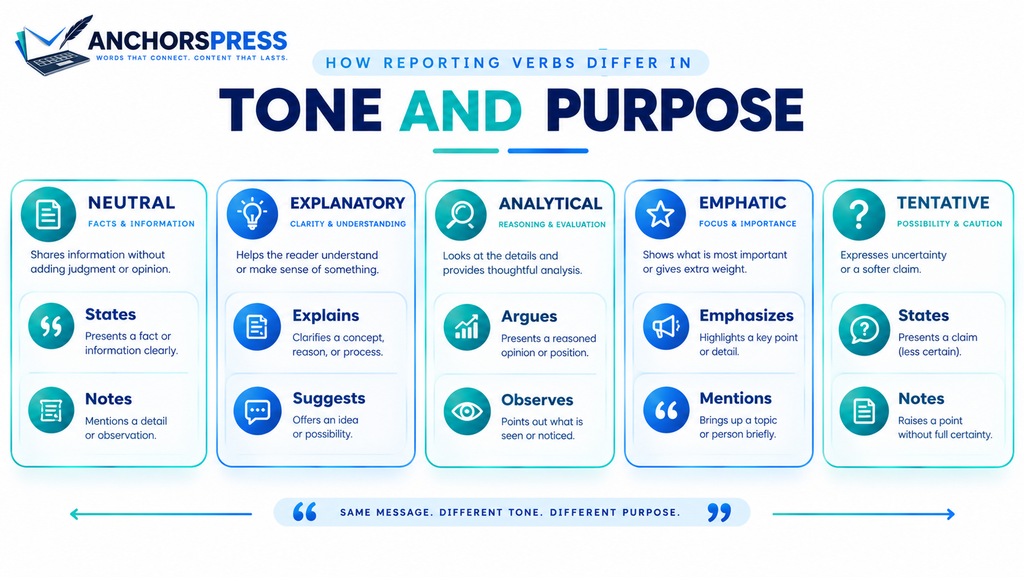
Think about what the author is doing. Use “explains” for clarification, “argues” for a supported opinion, “suggests” for an implied idea, and “emphasizes” for an important point. The right reporting verb should describe the author’s purpose without changing the meaning of the original text.
Conclusion
Finding another way to say “the author says” can make your essays, reports, and academic writing clearer and less repetitive. The best alternative depends on the author’s purpose and the context of the statement.
The most important rule is simple: choose a reporting verb that accurately reflects what the author is doing. When your wording matches the context, your writing sounds clearer, more natural, and more professional.
For more guidance, you can learn more about using reporting verbs in academic writing to choose words that accurately reflect an author’s ideas and arguments.

The Anchors Press Editorial Team writes and reviews every guide on this site. We check each alternative phrase against standard dictionaries and real usage, explain when it fits, and update articles when readers point out errors.