
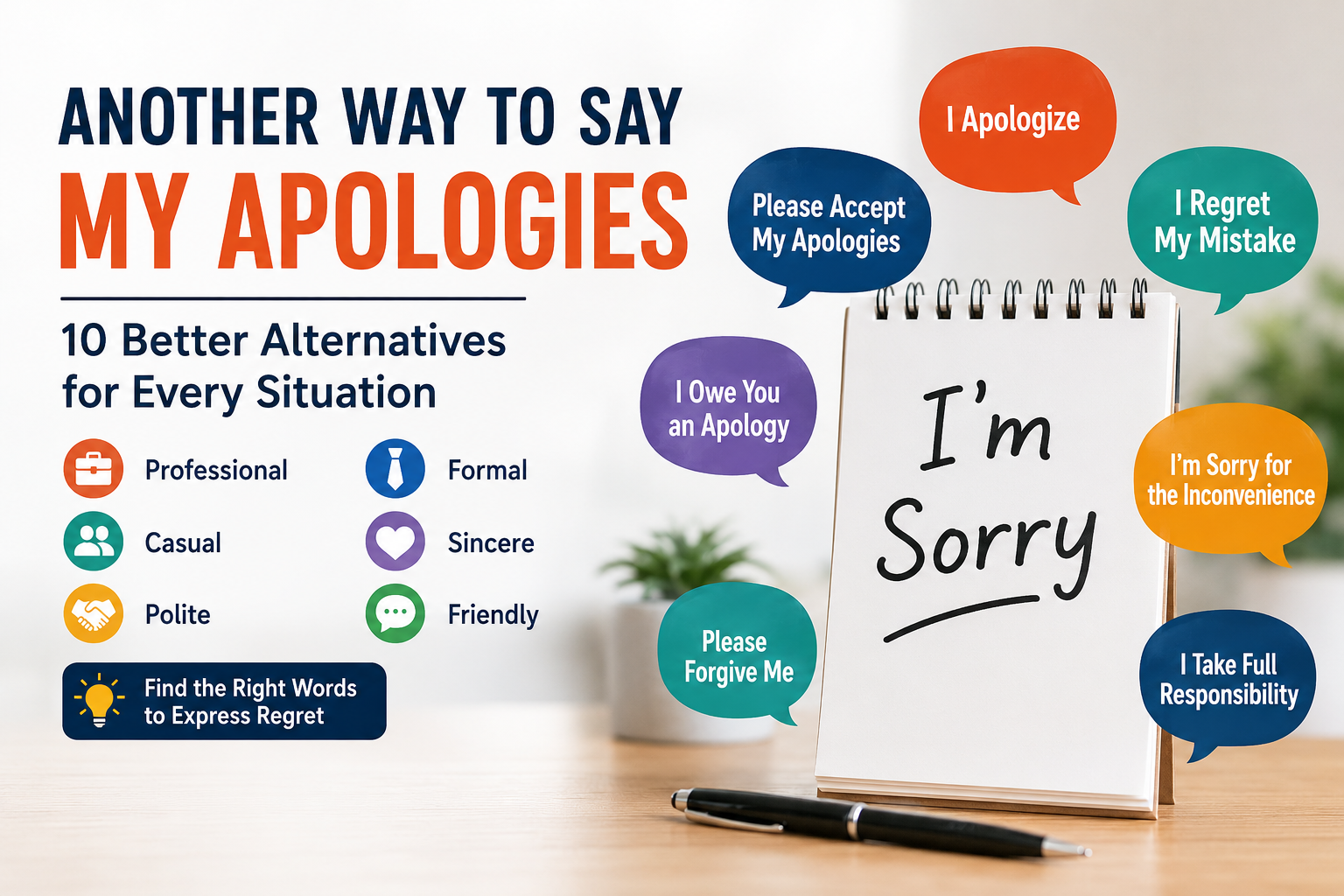
Looking for another way to say “my apologies” means finding a different expression that communicates regret or acknowledges a mistake.
“My apologies” is commonly used in emails, conversations, customer service messages, workplace communication, and formal situations. For example, you might say, “My apologies for the delayed response.”
People often look for alternatives because they want their apology to sound more natural or better match the seriousness of the situation. A casual mistake may call for “I’m sorry,” while a formal business issue may be better suited to “Please accept my apologies.”
Why Use Other Ways to Say “My Apologies”?
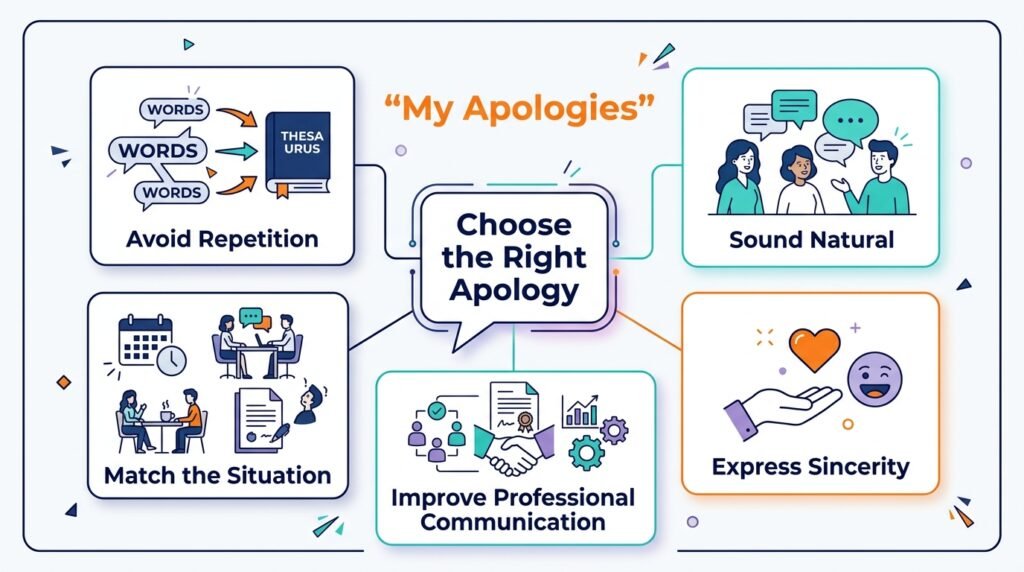
Using different apology phrases helps you communicate with greater precision. Instead of relying on the same expression every time, you can choose wording that matches your relationship with the other person and the situation.
Other benefits include:
- Avoiding repetitive language
- Making apologies sound more natural
- Matching formal and casual situations
- Showing greater sincerity
- Improving professional communication
- Expressing regret more clearly
- Choosing a warmer or more respectful tone
10 Best Other Ways to Say “My Apologies”
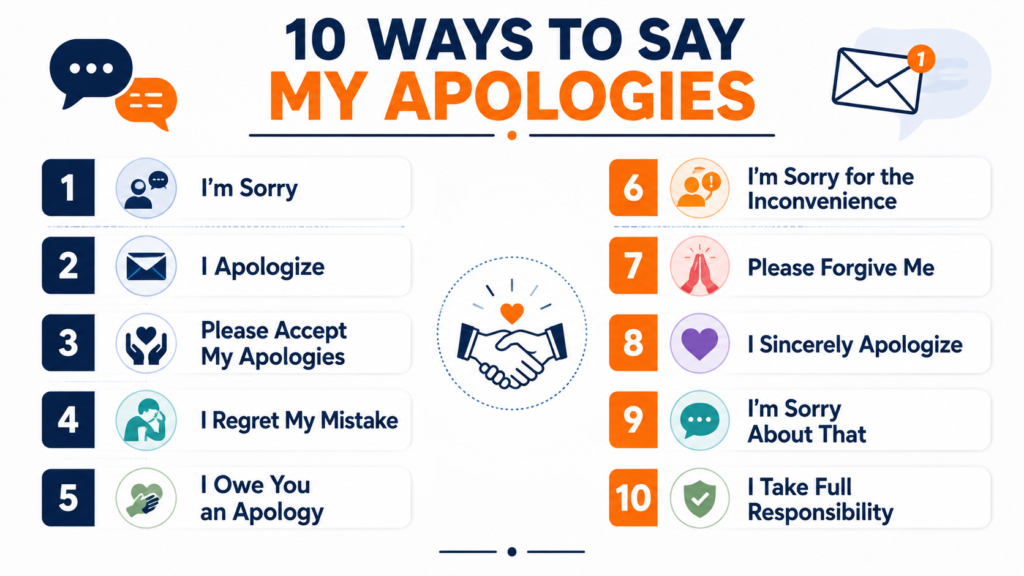
1. I’m Sorry
Meaning
“I’m sorry” is one of the most common and natural ways to apologize in American English. It directly expresses regret and works well in both personal conversations and many everyday professional situations.
Best For
- Casual
- Friendly
- Warm
- Polite
Example 1
I’m sorry I missed your call earlier; I was away from my phone.
Example 2
I’m sorry for the confusion about the meeting time.
Quick Tip
Use “I’m sorry” when you want your apology to sound genuine and conversational rather than overly formal.
2. I Apologize
Meaning
“I apologize” is a direct and professional alternative to “my apologies.” It clearly accepts responsibility and is especially useful when addressing a mistake in workplace communication.
Best For
- Professional
- Formal
- Polite
Example 1
I apologize for sending the wrong document with the original email.
Example 2
I apologize for the delay in responding to your request.
Quick Tip
Choose “I apologize” when you want to sound professional without making your apology unnecessarily elaborate.
3. Please Accept My Apologies
Meaning
“Please accept my apologies” is a respectful expression that communicates sincere regret. It has a more formal tone than “I’m sorry,” making it appropriate for serious or official situations.
Best For
- Formal
- Professional
- Polite
Example 1
Please accept my apologies for any inconvenience this scheduling change may have caused.
Example 2
Please accept my apologies for the error in the report.
Quick Tip
Use this phrase when you want to make your apology sound especially respectful or thoughtful.
4. I Regret My Mistake
Meaning
“I regret my mistake” directly acknowledges that something went wrong and shows that you feel genuine remorse. It can sound more serious than a simple “I’m sorry.”
Best For
- Formal
- Professional
- Polite
Example 1
I regret my mistake and will make sure the information is corrected today.
Example 2
I regret my mistake and understand why it caused frustration for the team.
Quick Tip
This phrase works best when you want to take clear responsibility instead of offering a vague apology.
5. I Owe You an Apology
Meaning
“I owe you an apology” recognizes that another person deserves an apology from you. It can sound personal and sincere because it openly acknowledges your responsibility.
Best For
- Casual
- Friendly
- Warm
- Polite
Example 1
I owe you an apology for assuming you had received the updated schedule.
Example 2
I owe you an apology for the way I handled our conversation yesterday.
Quick Tip
Use this expression when you want to emphasize personal responsibility and show that you understand the other person’s feelings.
6. I’m Sorry for the Inconvenience
Meaning
This phrase focuses on the trouble or difficulty your actions caused. It is common in customer service, workplace communication, scheduling issues, and other situations involving inconvenience.
Best For
- Professional
- Polite
- Friendly
Example 1
I’m sorry for the inconvenience caused by the unexpected delivery delay.
Example 2
I’m sorry for the inconvenience while we work to resolve the issue.
Quick Tip
Use this phrase when the main problem is an inconvenience rather than a serious personal mistake.
7. Please Forgive Me
Meaning
“Please forgive me” is a more personal way to express regret. It asks the other person to forgive your actions, so it generally carries more emotional weight than “my apologies.”
Best For
- Warm
- Casual
- Friendly
- Polite
Example 1
Please forgive me for forgetting such an important date.
Example 2
Please forgive me for speaking before I understood the whole situation.
Quick Tip
Reserve this phrase for personal situations where you genuinely want to ask for forgiveness.
8. I Sincerely Apologize
Meaning
“I sincerely apologize” adds emphasis to a standard apology. The word “sincerely” signals that your regret is genuine, which makes the phrase useful for serious mistakes and important professional communication.
Best For
- Formal
- Professional
- Polite
Example 1
I sincerely apologize for the incorrect information included in the original proposal.
Example 2
I sincerely apologize for failing to communicate the change sooner.
Quick Tip
Use “sincerely” when the situation deserves a stronger expression of regret, but avoid adding it to minor apologies unnecessarily.
9. I’m Sorry About That
Meaning
“I’m sorry about that” is a relaxed and natural expression used when acknowledging a mistake or minor problem. It sounds less formal than “I apologize” and fits ordinary conversations well.
Best For
- Casual
- Friendly
- Warm
Example 1
I’m sorry about that—I thought you had already received the update.
Example 2
I’m sorry about that. Let me fix the problem for you.
Quick Tip
This is a good choice for quick, everyday apologies when a formal expression would feel too stiff.
10. I Take Full Responsibility
Meaning
“I take full responsibility” goes beyond simply expressing regret. It clearly accepts accountability for what happened and can make an apology stronger when you were directly responsible for a significant mistake.
Best For
- Professional
- Formal
- Polite
Example 1
I take full responsibility for the error and have already corrected the figures.
Example 2
I take full responsibility for missing the deadline and understand the impact it had on the project.
Quick Tip
Use this phrase for serious mistakes when accountability matters more than simply saying you are sorry.
Comparison Table
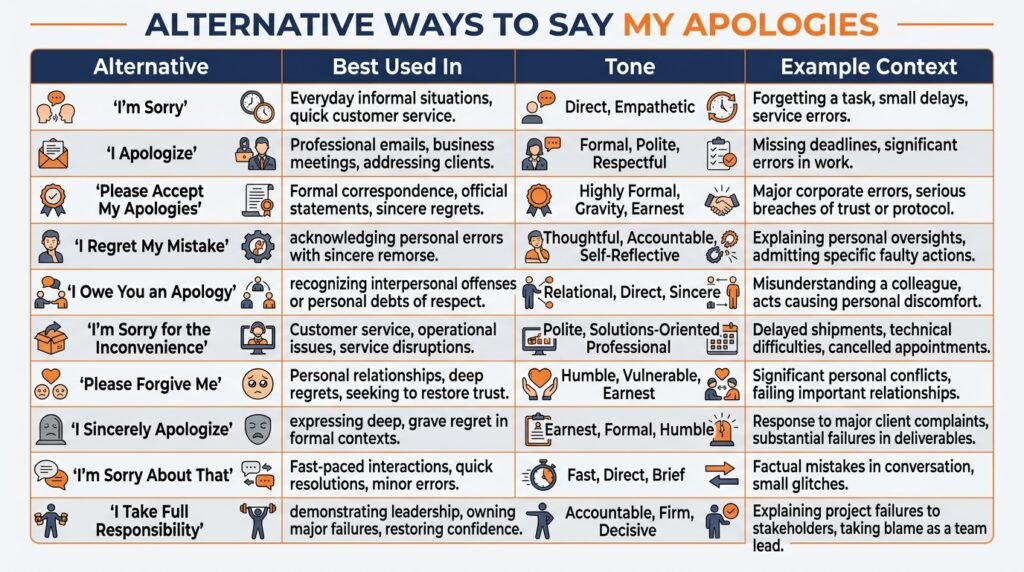
| Alternative | Best Used In | Tone |
| I’m sorry | Everyday conversations | Warm, natural |
| I apologize | Workplace and formal communication | Professional, polite |
| Please accept my apologies | Formal messages | Respectful, formal |
| I regret my mistake | Serious mistakes | Sincere, formal |
| I owe you an apology | Personal situations | Warm, sincere |
| I’m sorry for the inconvenience | Customer service and work | Professional, polite |
| Please forgive me | Personal relationships | Emotional, warm |
| I sincerely apologize | Serious professional situations | Formal, sincere |
| I’m sorry about that | Casual conversations | Relaxed, friendly |
| I take full responsibility | Significant mistakes | Accountable, professional |
Common Mistakes
1. Using Casual Phrases in Professional Emails
Phrases such as “I’m sorry about that” can sound too relaxed in certain business situations. For serious workplace issues, “I apologize” or “I sincerely apologize” may be more appropriate.
2. Choosing Overly Formal Language
Not every apology needs to sound official. Saying “Please accept my apologies” to a close friend over a minor mistake may feel unnecessarily stiff.
3. Repeating the Same Phrase
Using “my apologies” in every email can make your writing repetitive. Vary your wording when the context allows it, but make sure the alternative still sounds natural.
4. Forgetting the Context
The seriousness of the situation should guide your word choice. A missed text message does not require the same language as a major professional error.
5. Sounding Insincere
An apology can lose its impact when it feels automatic or vague. When appropriate, briefly acknowledge what went wrong and explain how you will correct it.
Frequently Asked Questions
What is a better way to say “my apologies”?
A natural alternative is “I’m sorry,” especially in everyday conversations. For professional situations, “I apologize” is often a stronger choice. If you need a more formal expression, try “Please accept my apologies.” The best option depends on the seriousness of the situation and the relationship between you and the person receiving the apology.
Is “I apologize” better than “my apologies”?
Neither phrase is always better. “I apologize” is a complete statement and often sounds more direct and professional, while “my apologies” is a concise expression of regret. In a business email, “I apologize for the delay” may sound more personal and direct than simply writing “My apologies for the delay.”
What can I say instead of “my apologies” in an email?
You can write “I’m sorry,” “I apologize,” “I sincerely apologize,” or “Please accept my apologies.” For a professional email, “I apologize for the delay” is usually clear and natural. For a more formal situation, “Please accept my apologies for the inconvenience” can provide a more respectful tone.
What is a casual way to say “my apologies”?
“I’m sorry” is the most common casual alternative. You can also say “I’m sorry about that” when acknowledging a small mistake or inconvenience. These expressions sound natural in conversations with friends, family members, coworkers, and other people with whom you have a relaxed relationship.
How do you say “my apologies” professionally?
For professional communication, use phrases such as “I apologize,” “I sincerely apologize,” or “Please accept my apologies.” When possible, identify the issue instead of giving a vague apology. For example, “I apologize for the delay in sending the report” is clearer and more useful than simply saying “My apologies.”
Is “please forgive me” a good alternative to “my apologies”?
“Please forgive me” can be a good alternative when the situation is personal or emotional. However, it may sound too strong for a minor workplace mistake. It directly asks the other person for forgiveness, so it is usually better suited to meaningful personal situations.
How do you apologize without saying “sorry”?
You can say “I apologize,” “I regret my mistake,” “I owe you an apology,” “Please accept my apologies,” or “I take full responsibility.” These alternatives let you express regret without using the word “sorry.” Choose the phrase according to the seriousness and formality of the situation.
What is the most sincere way to apologize?
A sincere apology usually combines clear responsibility with genuine regret. Phrases such as “I sincerely apologize” or “I take full responsibility” can communicate that you recognize your mistake. When appropriate, add a brief explanation of how you plan to fix the problem rather than relying on an apology alone.
Conclusion
Finding another way to say “my apologies” can make your communication sound more natural, sincere, and appropriate for the situation. The best alternative depends on the relationship, setting, and seriousness of the mistake.
For everyday situations, “I’m sorry” is simple and genuine. In professional communication, “I apologize” offers a clear and polished option, while “Please accept my apologies” works well in more formal situations. If you want to show accountability, “I take full responsibility” makes that message especially clear.
The key is to match your words to the situation rather than choosing the most formal phrase available. A thoughtful, specific apology will almost always communicate more effectively than a complicated one.