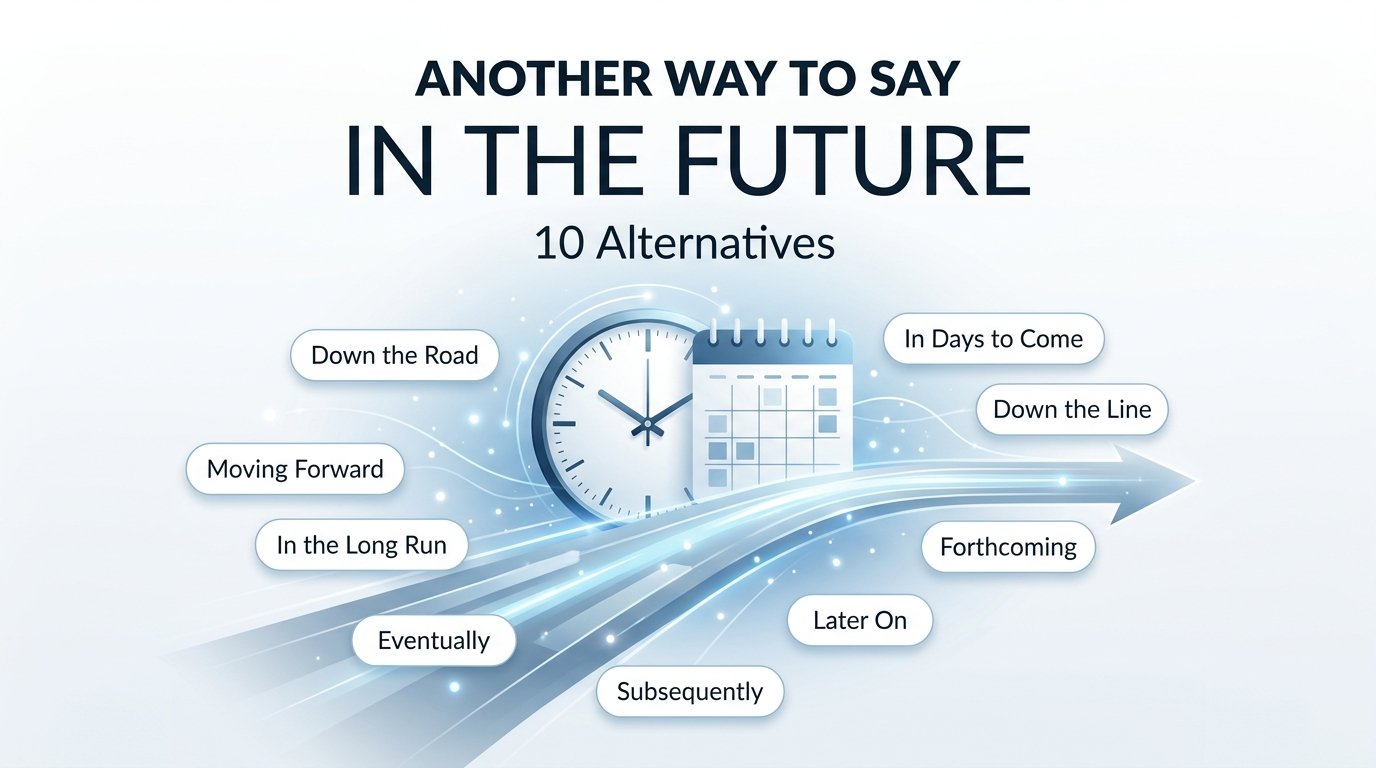
The phrase “in the future” is common, clear, and grammatically correct.
However, using the same expression repeatedly can make your writing sound predictable.
Fortunately, English offers many natural alternatives. Some work best in professional settings, while others fit casual conversations, personal writing, or situations where you want to describe a specific point later in time.
What Does “Another Way to Say In the Future” Mean?
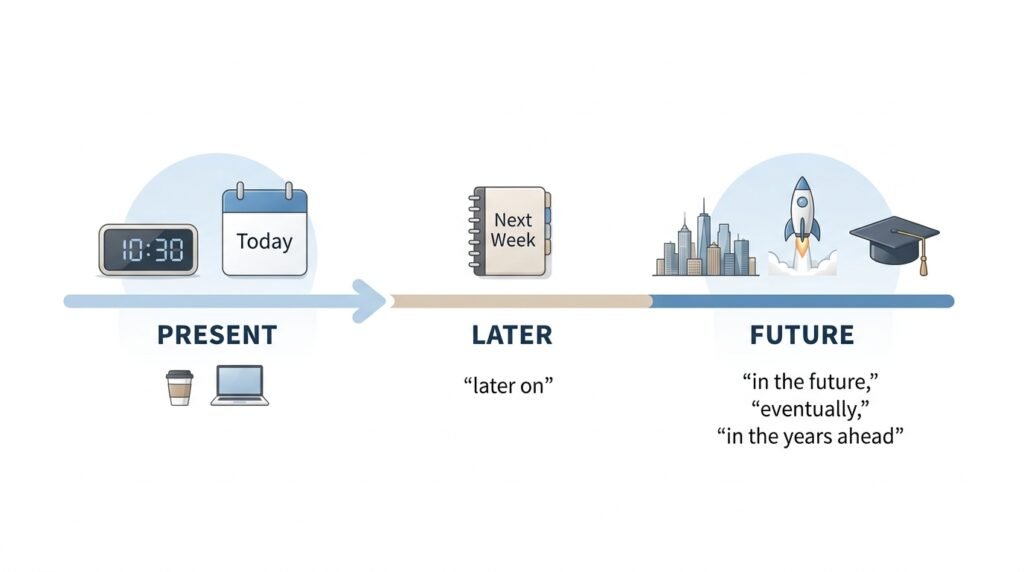
“Another way to say in the future” means looking for a different word or phrase that communicates something will happen at a time after the present.
People often search for alternatives to “in the future” when they want to avoid repetition, improve their vocabulary, or make their writing better suited to a particular situation.
For example, “going forward” can sound natural in a workplace discussion, while “down the road” is more conversational. “At a later date” is more formal and often appears in business or official communication.
The right expression depends on what you mean and how soon or far away the event may occur.
Why Use Other Ways to Say “In the Future”?
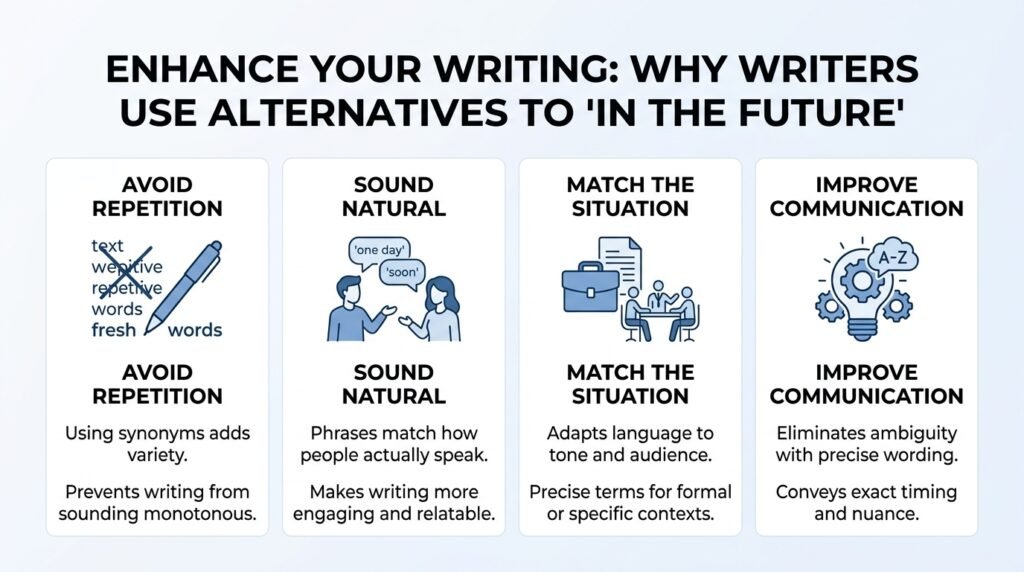
Replacing “in the future” can make your communication more precise and natural. It also allows you to show the relationship between the present and a later event more clearly.
Using different expressions can help you:
- Avoid repeating the same phrase.
- Make your writing sound more natural.
- Match your language to the situation.
- Communicate a specific sense of time.
- Sound more professional when appropriate.
- Make casual conversations feel less formal.
- Add variety to essays, emails, and articles.
The key is not simply to replace the phrase every time. Choose an alternative that accurately fits the context.
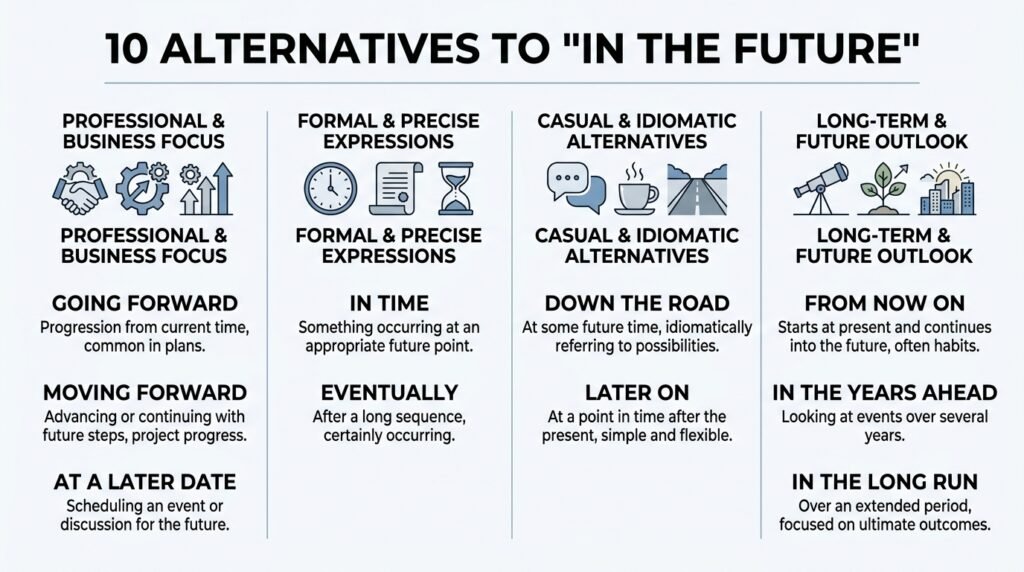
10 Best Other Ways to Say “In the Future”
1. Going Forward
Meaning
“Going forward” refers to what will happen from this point onward. It is especially common when discussing decisions, policies, expectations, or changes.
Best For
- Professional
- Formal
- Polite
Example 1
Going forward, our team will review customer feedback every Friday.
Example 2
Going forward, please submit all expense reports by the end of the month.
Quick Tip
Use “going forward” when you are talking about actions or expectations that begin now and continue later.
2. Moving Forward
Meaning
“Moving forward” means continuing from the present into the future. It often appears when people discuss plans, solutions, progress, or the next stage of a project.
Best For
- Professional
- Formal
- Polite
Example 1
Moving forward, we will focus on improving the customer experience.
Example 2
The company plans to expand its online services moving forward.
Quick Tip
This phrase is useful when you want to connect a current decision with future action.
3. Down the Road
Meaning
“Down the road” is an informal expression meaning at some point in the future. It usually suggests a future time without specifying exactly when it will happen.
Best For
- Casual
- Friendly
- Warm
Example 1
We may consider opening a second location down the road.
Example 2
Down the road, I’d love to learn another language.
Quick Tip
Use “down the road” in conversations, blogs, and informal writing rather than formal business documents.
4. At a Later Date
Meaning
“At a later date” refers to a time after the present that has not been specified. It has a formal and neutral tone.
Best For
- Professional
- Formal
- Polite
Example 1
The committee will announce the final decision at a later date.
Example 2
We will provide additional information at a later date.
Quick Tip
Choose this phrase when you want to mention a future event without committing to a specific date.
5. In Time
Meaning
“In time” can mean eventually or after enough time has passed. Depending on the sentence, it may suggest that something will happen naturally as circumstances develop.
Best For
- Formal
- Casual
- Warm
Example 1
With regular practice, she will become more confident in time.
Example 2
In time, the new system should become easier for employees to use.
Quick Tip
Do not confuse “in time” with “on time.” “In time” focuses on eventual timing, while “on time” means punctuality.
6. Eventually
Meaning
“Eventually” means at some point after a period of time, often following a process, delay, or series of events. It is useful when the exact timing is unknown or unimportant.
Best For
- Professional
- Formal
- Casual
Example 1
The small startup eventually became a successful national brand.
Example 2
If you keep practicing, you’ll eventually feel comfortable speaking in public.
Quick Tip
Use “eventually” when you want to emphasize the final outcome rather than the exact future date.
7. From Now On
Meaning
“From now on” means beginning at the present moment and continuing into the future. It is often used when announcing a new habit, rule, decision, or expectation.
Best For
- Casual
- Friendly
- Polite
Example 1
From now on, I’ll keep a backup copy of every important file.
Example 2
We agreed to communicate more clearly from now on.
Quick Tip
Use this expression when the change starts now, rather than at an unspecified point later.
8. In the Years Ahead
Meaning
“In the years ahead” refers to a period extending into the future, usually over several years. It works well when discussing long-term plans, development, or expectations.
Best For
- Formal
- Professional
- Warm
Example 1
The new technology could transform education in the years ahead.
Example 2
We hope to build a stronger community in the years ahead.
Quick Tip
This phrase is best when you are discussing long-term developments rather than something that may happen next week or next month.
9. Later On
Meaning
“Later on” is a casual way to refer to a time after the present. It can describe something that will happen later the same day, at another time, or farther into the future.
Best For
- Casual
- Friendly
- Warm
Example 1
Let’s talk about the budget later on when everyone is available.
Example 2
I might take a photography class later on.
Quick Tip
Use “later on” when the exact timing is not important and the tone is conversational.
10. In the Long Run
Meaning
“In the long run” refers to the eventual result or effect of something over a longer period. It focuses more on long-term consequences than simply indicating a future time.
Best For
- Professional
- Formal
- Casual
Example 1
Investing in quality equipment will save the company money in the long run.
Example 2
Learning strong communication skills can benefit your career in the long run.
Quick Tip
Use “in the long run” when discussing long-term benefits, consequences, or outcomes rather than a specific future event.
Comparison Table
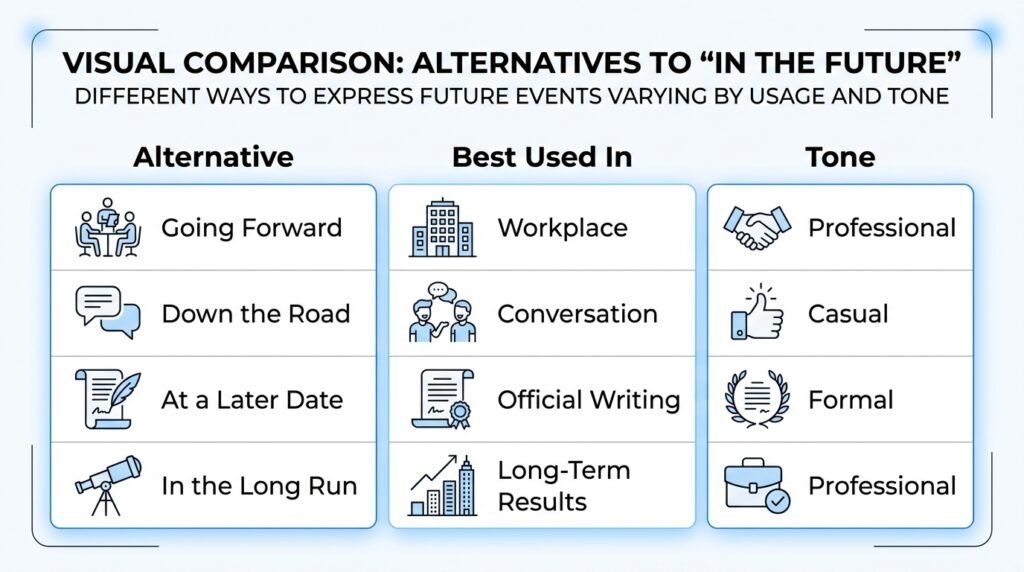
| Alternative | Best Used In | Tone |
| Going forward | Workplace, business communication | Professional |
| Moving forward | Plans, projects, professional writing | Professional |
| Down the road | Everyday conversation | Casual |
| At a later date | Business, official communication | Formal |
| In time | Long-term development | Neutral |
| Eventually | Outcomes and processes | Neutral |
| From now on | Rules, habits, decisions | Casual/Polite |
| In the years ahead | Long-term plans and predictions | Formal/Warm |
| Later on | Everyday conversation | Casual |
| In the long run | Long-term effects and benefits | Neutral/Professional |
Common Mistakes
1. Using Casual Phrases in Professional Emails
Expressions such as “down the road” and “later on” can sound too relaxed in formal correspondence. Choose “at a later date” or “going forward” when the situation calls for a professional tone.
2. Choosing an Overly Formal Expression
Not every sentence needs formal vocabulary. Saying “at a later date” in a casual conversation can sound stiff when “later on” would feel more natural.
3. Repeating the Same Phrase
Using “in the future” several times in a short passage can make your writing repetitive. Vary your wording when the alternatives genuinely fit the meaning.
4. Forgetting the Context
Not every synonym has exactly the same meaning. “From now on” suggests something begins immediately, while “in the years ahead” points toward a longer future period.
5. Sounding Insincere or Vague
Some future-oriented phrases can make a statement unnecessarily vague. If you know when something will happen, consider giving a specific time or date instead of using a general expression.
Frequently Asked Questions
What is another way to say “in the future”?
Common alternatives include “going forward,” “moving forward,” “eventually,” “down the road,” “at a later date,” “from now on,” and “later on.” The best choice depends on the context. For professional writing, “going forward” is often effective, while “down the road” sounds more natural in casual conversation.
What is a professional way to say “in the future”?
“Going forward” and “moving forward” are two common professional alternatives. “At a later date” is another good option when you want to refer to an unspecified future time. Choose the phrase that matches your meaning instead of replacing “in the future” automatically.
What is a casual way to say “in the future”?
For casual conversations, “down the road,” “later on,” and “from now on” can work well. For example, you might say, “We can figure that out down the road.” These expressions sound relaxed and natural in everyday American English.
Is “moving forward” the same as “in the future”?
They are similar, but they are not always interchangeable. “Moving forward” usually emphasizes continuing from the present, often after a decision or change. “In the future” is broader and simply refers to a time after now. Context determines which expression sounds more natural.
Can I use “going forward” in an email?
Yes. “Going forward” is widely used in professional emails, especially when discussing new procedures, expectations, plans, or decisions. For example, “Going forward, please send invoices to the accounting department.” However, avoid using it repeatedly because it can become repetitive.
What is another way to say “in the future” in an essay?
For essays, options such as “in the years ahead,” “eventually,” “in the long run,” and “in time” can add variety. The best choice depends on the sentence. Academic writing should prioritize precise meaning rather than using a synonym simply to avoid repetition.
Is “down the road” formal or informal?
“Down the road” is generally informal. It is common in American conversations and relaxed writing, particularly when discussing possibilities or plans that may happen later. For formal reports, business documents, or academic writing, a phrase such as “at a later date” may be more appropriate.
What is the difference between “from now on” and “in the future”?
“From now on” indicates that something starts at the present moment and continues afterward. “In the future” simply refers to a later time. For example, “From now on, we will meet weekly” describes an immediate change, while “We may expand in the future” describes a possibility later.
Conclusion
Finding another way to say “in the future” can make your writing more natural, precise, and engaging. The best alternative depends on the context and the type of future you want to describe.
For professional communication, “going forward” and “moving forward” are strong choices. If you want to describe an unspecified later time, “at a later date” works well. For casual conversations, “down the road” and “later on” sound more relaxed.
When discussing long-term results, “in the long run” is more precise, while “eventually” emphasizes an eventual outcome. The key is to choose the phrase that matches your meaning rather than simply replacing words for variety.