
The phrase “another way to say according” usually refers to alternatives to “according to.” The phrase “according to” is commonly used when you want to attribute information, opinions, facts, or statements to a particular source.
For example, you might write, “According to the report, sales increased this year.” Here, the phrase shows that the information comes from the report rather than from the writer.
People often search for alternatives because repeating “according to” can make an article, essay, email, or report sound repetitive. A suitable replacement can also make the relationship between the source and the information clearer.
Why Use Other Ways to Say “According To”?
Using alternatives can make your writing more precise and natural. However, the replacement should still accurately communicate where the information comes from.
Common reasons to use another expression include:
- Avoid repetition: Prevent the same phrase from appearing throughout an article.
- Sound more natural: Choose wording that fits conversational or academic writing.
- Match different situations: Some expressions work better for reports, conversations, or journalism.
- Improve professional communication: More precise wording can make business writing clearer.
- Show the source clearly: Certain alternatives explain whether information was reported, stated, suggested, or supported by evidence.
10 Best Other Ways to Say “According To”
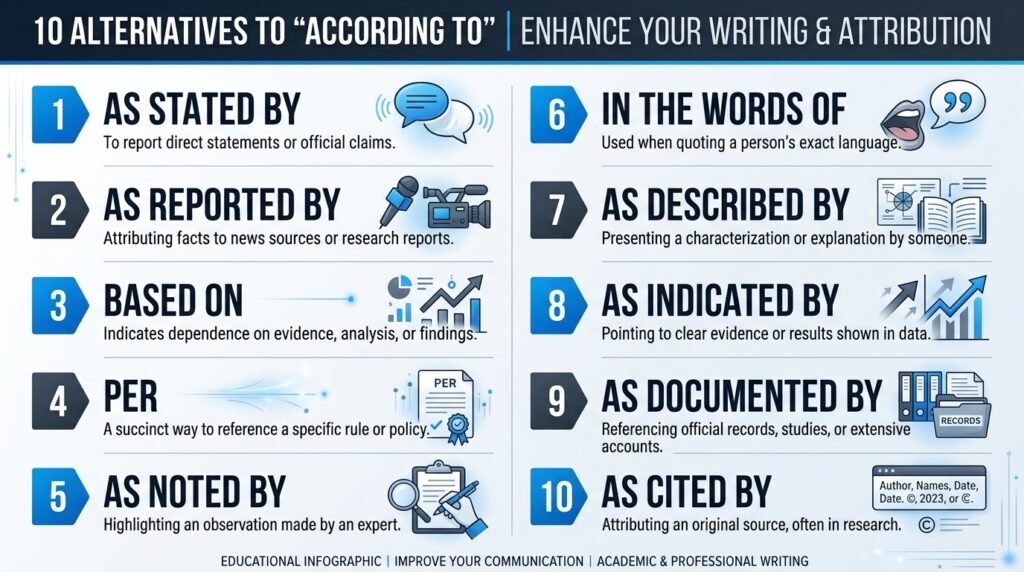
1. As Stated By
Meaning
“As stated by” means that information comes directly from a person, organization, document, or other source. It is especially useful when you want to emphasize what a source explicitly said.
Best For
- Professional
- Formal
- Polite
Example 1
As stated by the company’s annual report, customer satisfaction improved significantly.
Example 2
As stated by the professor, students should review the material before the exam.
Quick Tip
Use “as stated by” when the source actually made a statement, rather than simply provided data.
2. As Reported By
Meaning
“As reported by” indicates that information was published or communicated by a news organization, researcher, agency, or other reporting source. It works particularly well when discussing current events or published findings.
Best For
- Professional
- Formal
Example 1
As reported by the local newspaper, the bridge will reopen next month.
Example 2
As reported by the research team, the new treatment showed promising results.
Quick Tip
Choose this phrase when the source is reporting information, especially in journalism or research-related writing.
3. Based On
Meaning
“Based on” shows that an idea, conclusion, decision, or statement comes from particular evidence or information. Unlike “according to,” it often focuses more on the evidence behind a conclusion.
Best For
- Professional
- Formal
- Casual
Example 1
Based on the latest survey, most customers prefer the updated design.
Example 2
Based on the available evidence, the team decided to postpone the launch.
Quick Tip
Use “based on” when you want to emphasize the evidence or information supporting something, not simply identify a source.
4. As Noted By
Meaning
“As noted by” means that a person or source previously pointed out, mentioned, or observed something. It has a polished tone and fits academic, business, and professional writing.
Best For
- Professional
- Formal
Example 1
As noted by the manager, several departments still need additional training.
Example 2
As noted by the study’s authors, the results require further investigation.
Quick Tip
This expression is particularly useful when the source has already highlighted an important detail.
5. In the Words Of
Meaning
“In the words of” introduces an idea or statement using the perspective or language of a particular person. It can sound more personal and expressive than “according to.”
Best For
- Friendly
- Warm
- Formal
Example 1
In the words of the author, success requires patience and consistent effort.
Example 2
In the words of our coach, every small improvement matters.
Quick Tip
Use this phrase when you want to draw attention to a person’s own perspective or memorable wording.
6. As Indicated By
Meaning
“As indicated by” suggests that information, evidence, or signs point toward a particular conclusion. It is common in analytical, technical, and professional writing.
Best For
- Professional
- Formal
Example 1
As indicated by the survey results, younger customers prefer online support.
Example 2
As indicated by the financial data, operating costs have declined.
Quick Tip
Use it when evidence or data points toward a conclusion, rather than when someone simply gives an opinion.
7. As Mentioned By
Meaning
“As mentioned by” refers to something that a person or source has previously brought up. It sounds natural and is useful when connecting your current point to an earlier statement.
Best For
- Casual
- Friendly
- Professional
Example 1
As mentioned by Sarah, the meeting has been moved to Thursday.
Example 2
As mentioned by the instructor, the assignment must be submitted online.
Quick Tip
This is a good choice when the information has already been brought up in the conversation or discussion.
8. As Per
Meaning
“As per” is a formal expression meaning “in accordance with” or “as stated in.” It is frequently used in business and administrative communication, although “according to” or “as stated in” may sound more natural in everyday American English.
Best For
- Professional
- Formal
Example 1
As per the contract, payment must be received within 30 days.
Example 2
As per the updated schedule, the workshop will begin at 9 a.m.
Quick Tip
Use “as per” carefully. In American English, it can sound somewhat bureaucratic, so “according to” or “under the agreement” may be smoother in some contexts.
9. In Line With
Meaning
“In line with” means that something agrees with, follows, or is consistent with a particular policy, standard, recommendation, or expectation. It is not always a direct replacement for “according to.”
Best For
- Professional
- Formal
Example 1
The company changed its policy in line with new industry standards.
Example 2
The proposal was revised in line with the client’s recommendations.
Quick Tip
Use this expression when you mean “consistent with” rather than simply “someone said.”
10. As Explained By
Meaning
“As explained by” introduces information that a person has clarified or described. It works well when the source provides reasoning, instructions, or an explanation rather than a simple statement.
Best For
- Professional
- Formal
- Friendly
Example 1
As explained by the technician, the system needs a software update.
Example 2
As explained by the teacher, the final grade includes both projects and exams.
Quick Tip
Choose “as explained by” when the source has provided an explanation or reasoning behind the information.
Comparison Table
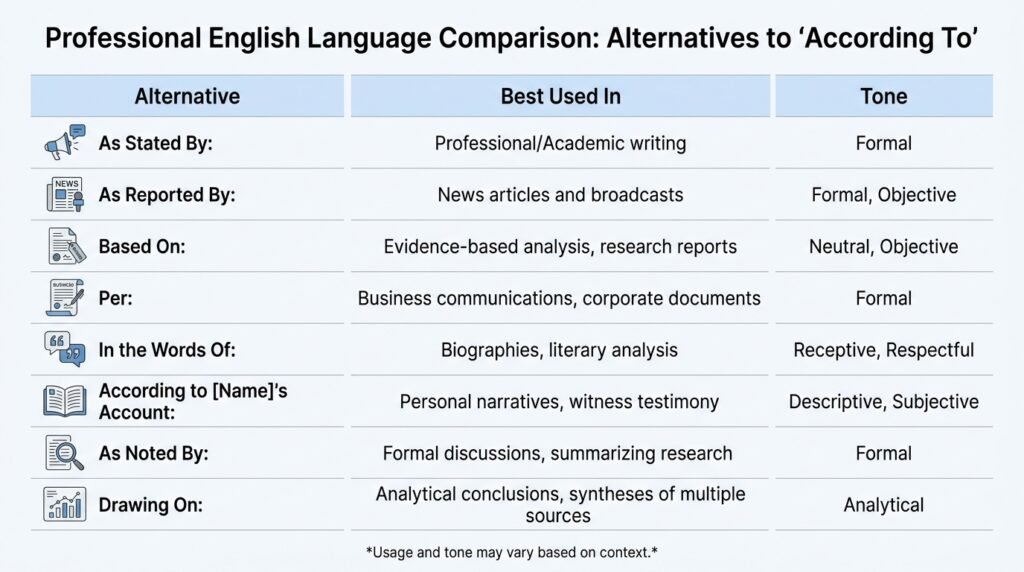
| Alternative | Best Used In | Tone |
| As stated by | Reports, academic writing | Formal |
| As reported by | News, research, journalism | Formal |
| Based on | Data, evidence, analysis | Professional |
| As noted by | Essays, reports, business writing | Formal |
| In the words of | Quotes, speeches, personal writing | Warm |
| As indicated by | Research, statistics, analysis | Formal |
| As mentioned by | Conversations, emails, discussions | Casual/Professional |
| As per | Business, policies, agreements | Formal |
| In line with | Policies, standards, recommendations | Professional |
| As explained by | Instructions, explanations, teaching | Professional |
Common Mistakes
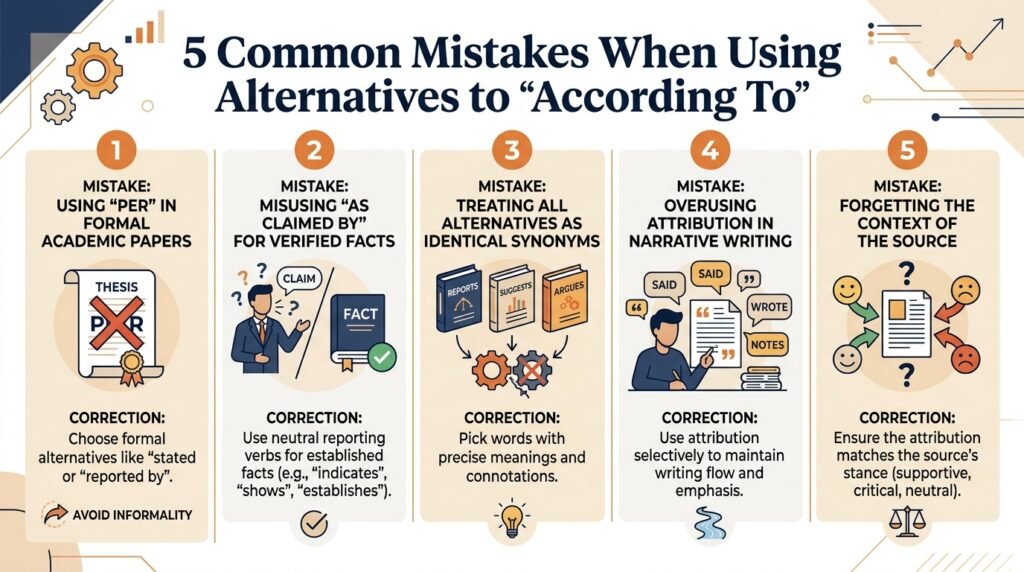
1. Using Casual Phrases in Professional Emails
Not every alternative sounds appropriate in a business email. Expressions such as “in the words of” may feel too personal when you simply need to reference a company policy.
2. Choosing Overly Formal Language
Some writers replace “according to” with unnecessarily complex wording. If “according to the report” sounds clear and natural, there is no need to force a more complicated alternative.
3. Repeating the Same Phrase
Using “according to” several times in consecutive paragraphs can make your writing feel mechanical. Vary the wording when the context genuinely supports another expression.
4. Forgetting Context
Not every alternative has exactly the same meaning. For example, “based on” emphasizes evidence, while “as stated by” emphasizes a source’s specific statement.
5. Sounding Insincere
Choosing an extremely formal phrase for a simple conversation can create unnecessary distance. Match your wording to the relationship, audience, and purpose.
Frequently Asked Questions
What is the best synonym for “according to”?
The best synonym depends on the context. “As stated by” works well when referring to someone’s exact statement, while “as reported by” suits news or published information. “Based on” is better when your sentence focuses on evidence or data rather than the source itself.
What is a formal way to say “according to”?
Formal alternatives include “as stated by,” “as noted by,” “as indicated by,” and “as reported by.” The right choice depends on what the source contributed. For example, “as indicated by the data” is appropriate when statistics support your point, while “as stated by the director” refers to a person’s statement.
What is a professional way to say “according to”?
In professional writing, you can use “as stated by,” “as noted by,” “as reported by,” or “based on.” These phrases can make business reports, presentations, and emails more varied. Still, “according to” remains completely professional and should not be replaced simply for the sake of using a different phrase.
Can I use “based on” instead of “according to”?
Sometimes, but the meanings are not identical. “According to the survey” identifies the survey as the source of information. “Based on the survey” suggests that your conclusion, decision, or statement relies on the survey’s findings. Choose the phrase that best describes the relationship between your claim and the source.
Is “as per” the same as “according to”?
“As per” can sometimes mean the same thing as “according to,” especially when referring to rules, agreements, or instructions. However, it can sound more bureaucratic in American English. In many situations, “according to,” “as stated in,” or “under the agreement” will sound more natural.
What can I say instead of “according to” in an essay?
For an essay, useful choices include “as stated by,” “as noted by,” “as reported by,” “as indicated by,” and “based on.” Your choice should reflect the source. Academic writing benefits from precise attribution, so avoid selecting a synonym merely because it sounds more sophisticated.
How can I avoid repeating “according to”?
First, determine why you are using the phrase. If you are citing a statement, try “as stated by” or “as noted by.” If you are discussing evidence, “based on” or “as indicated by” may work better. You can also restructure the sentence so the source appears naturally without an attribution phrase.
Is “in the words of” a good alternative to “according to”?
Yes, but it serves a more specific purpose. “In the words of” highlights someone’s own perspective, expression, or quotation. It works especially well in speeches, essays, profiles, and personal writing. For a straightforward business report, “as stated by” or “according to” will usually be more direct.
Conclusion
Finding another way to say “according to” can make your writing more varied, precise, and natural. The best alternative depends on what you want to emphasize. Use “as stated by” when referring to a person’s statement, “as reported by” for published or reported information, and “based on” when evidence supports a conclusion.
For a professional tone, “as noted by” and “as indicated by” are useful choices. In more personal writing, “in the words of” can add warmth and personality. The key is not to replace “according to” every time you see it. Instead, choose an expression that accurately reflects the source, evidence, and tone of your sentence.