
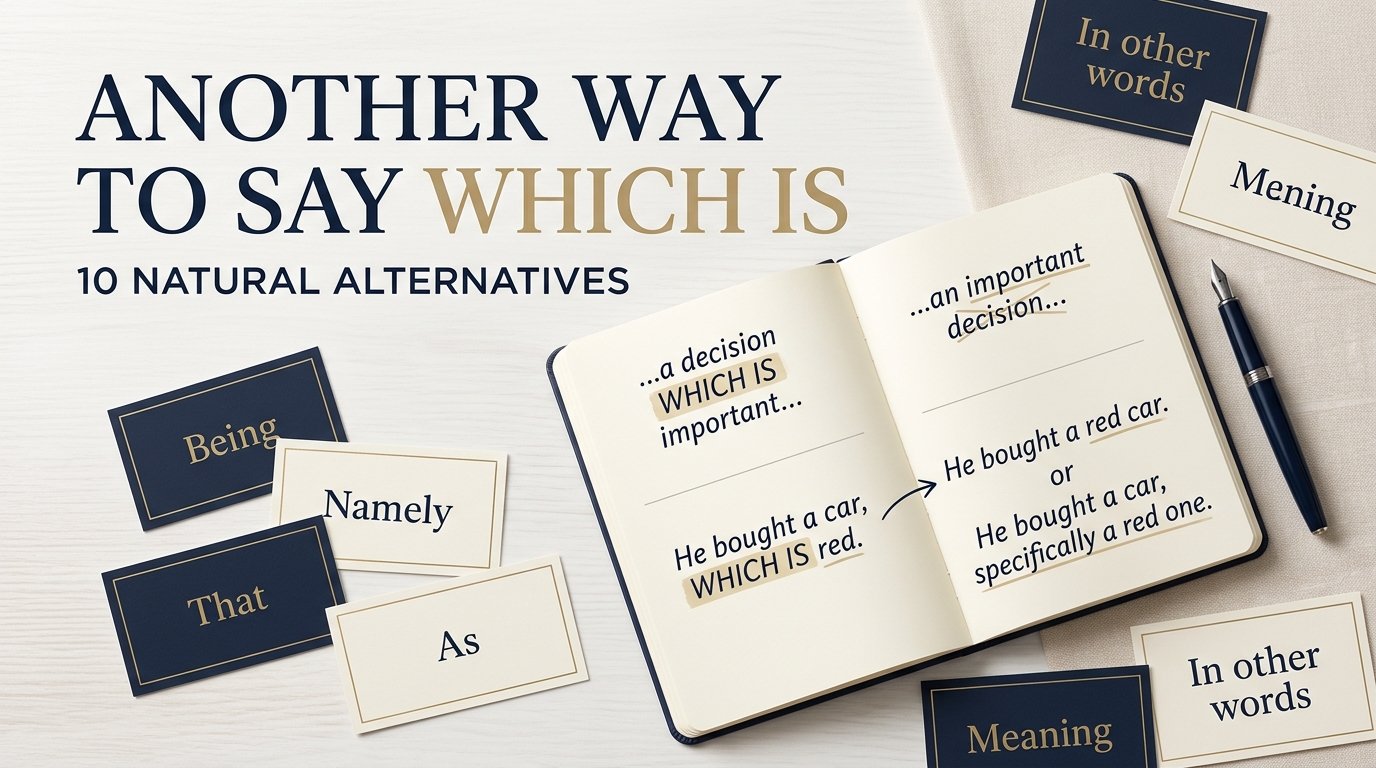
The phrase “which is” is common in English, but using it repeatedly can make your writing sound predictable. Finding another way to say “which is” can help you make sentences clearer, smoother, and more varied.
The right replacement depends on what “which is” does in your sentence. It may introduce an explanation, clarify a meaning, identify something specific, or connect an idea to its result.
What Does “Which Is” Mean?
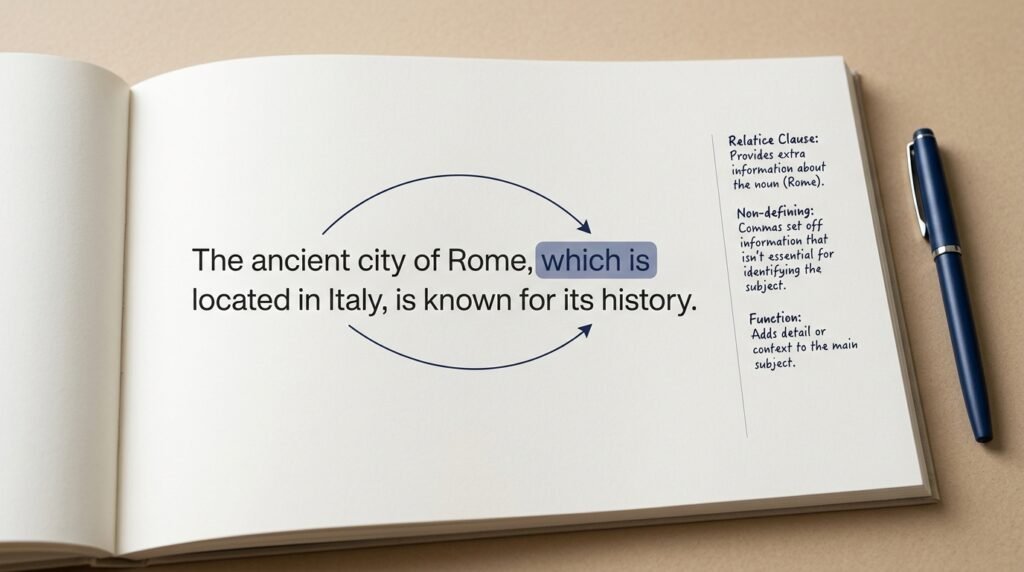
“Which is” is usually used to add information about a person, thing, situation, or idea that was already mentioned. It often introduces a description, explanation, or additional detail.
For example:
The meeting starts at 9 a.m., which is earlier than usual.
Here, “which is” introduces additional information about the meeting time.
You might also use it to explain something:
She chose the blue design, which is her favorite color.
The phrase is especially common in everyday conversation, academic writing, business communication, and general content writing.
Because “which is” can serve several purposes, there is no single replacement that works in every sentence. You should choose an alternative based on the relationship between the ideas.
Why Use Other Ways to Say “Which Is”?
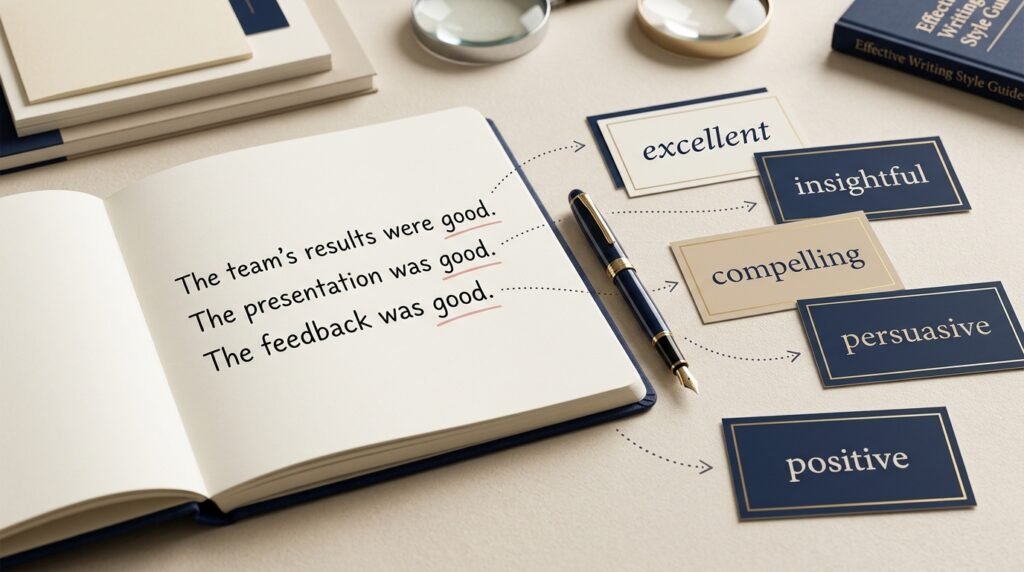
Using alternatives can make your writing more precise and natural. It can also prevent the same sentence structure from appearing again and again.
Consider alternatives when you want to:
- Avoid repetitive sentence patterns.
- Make an explanation easier to understand.
- Create a more professional tone.
- Introduce a specific fact or detail.
- Explain the meaning or result of something.
- Make academic or business writing more concise.
The key is not to replace “which is” automatically. Instead, choose a phrase that accurately expresses what you want to say.
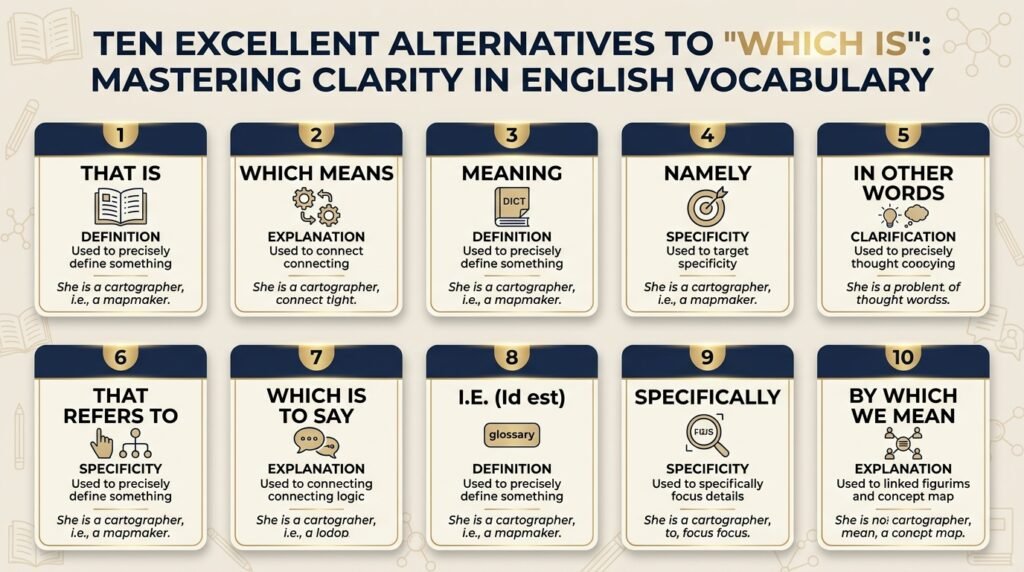
10 Best Other Ways to Say “Which Is”
1. That Is
Meaning
“That is” introduces a clarification or restatement of something already mentioned. It is especially useful when you want to explain an idea in a more direct way.
Best For
- Professional
- Formal
- Polite
Example 1
The project requires additional funding; that is, we need to increase the budget.
Example 2
She works remotely, that is, she completes her duties from home.
Quick Tip
Use “that is” when you are clarifying or restating information rather than simply adding a descriptive detail.
2. Which Means
Meaning
“Which means” explains the result, meaning, or consequence of something. It is one of the most natural choices when “which is” is being used to explain what something means.
Best For
- Casual
- Friendly
- Professional
Example 1
The store closes at six, which means we need to arrive before then.
Example 2
He missed the last train, which means he will have to take a taxi.
Quick Tip
Choose “which means” when the second part of your sentence explains a consequence or logical result.
3. Meaning
Meaning
“Meaning” provides a short explanation or clarification of what you have just said. It creates a conversational and concise connection between two ideas.
Best For
- Casual
- Friendly
- Professional
Example 1
The reservation was canceled, meaning we had to find another restaurant.
Example 2
She finished the assignment early, meaning she had extra time to review it.
Quick Tip
“Meaning” is particularly useful when you want to make a sentence shorter without losing its explanation.
4. Namely
Meaning
“Namely” identifies or specifies exactly what you are referring to. It is more formal than many everyday alternatives and works well when introducing a particular person, item, or fact.
Best For
- Formal
- Professional
Example 1
We have one major concern, namely, the lack of available staff.
Example 2
The company offers one premium service, namely, its annual consulting package.
Quick Tip
Use “namely” when you want to name or identify something specific, not simply describe it.
5. In Other Words
Meaning
“In other words” restates an idea using simpler or clearer language. It is helpful when the original statement might be difficult for the reader to understand.
Best For
- Friendly
- Casual
- Professional
Example 1
The instructions are optional; in other words, you do not have to complete them.
Example 2
The offer expires tonight; in other words, this is your last opportunity to use it.
Quick Tip
Use this phrase when your goal is to make an idea clearer rather than introduce completely new information.
6. That Means
Meaning
“That means” directly explains the significance or result of a previous statement. It sounds natural in everyday English and is easy for readers to understand.
Best For
- Casual
- Friendly
- Polite
Example 1
Your application has been approved. That means you can begin the program next month.
Example 2
The weather forecast predicts heavy rain. That means we should move the event indoors.
Quick Tip
Use “that means” when the second statement is a direct interpretation or consequence of the first.
7. Referring To
Meaning
“Referring to” identifies the person, thing, or idea being discussed. It works well when you need to make a reference clearer, especially in professional or explanatory writing.
Best For
- Professional
- Formal
Example 1
The final section discusses the new policy, referring to the rules introduced last month.
Example 2
The report mentions a major concern, referring to the shortage of qualified workers.
Quick Tip
Use this phrase when the main purpose is to clarify what a particular word, statement, or reference points to.
8. Defined As
Meaning
“Defined as” explains the exact meaning or accepted definition of a term. It is particularly appropriate for educational, technical, academic, and professional writing.
Best For
- Formal
- Professional
Example 1
Remote work is defined as performing job duties outside a traditional office.
Example 2
A short-term contract is defined as an agreement that lasts for a limited period.
Quick Tip
Use “defined as” when you are explaining the meaning of a term rather than simply adding information.
9. Also Known As
Meaning
“Also known as” introduces another name, title, or term for the same person, place, object, or concept. It is useful when readers may recognize something by a different name.
Best For
- Professional
- Casual
- Informative
Example 1
The Grand Canyon, also known as one of America’s most famous natural landmarks, attracts millions of visitors.
Example 2
The common cold, also known as a viral upper respiratory infection, usually causes mild symptoms.
Quick Tip
Use “also known as” only when the alternative phrase is genuinely another name or recognized term for the same thing.
10. Specifically
Meaning
“Specifically” narrows an idea and provides more exact information. It is a useful alternative when “which is” introduces a particular detail that makes the previous statement more precise.
Best For
- Professional
- Formal
- Polite
Example 1
We need to improve one part of the website, specifically, the checkout process.
Example 2
The team has one immediate priority, specifically, completing the customer survey.
Quick Tip
Use “specifically” when you are narrowing a broad statement to one exact point.
Comparison Table
| Alternative | Best Used In | Tone |
| That is | Professional explanations | Formal, clear |
| Which means | Results and consequences | Natural, explanatory |
| Meaning | Brief explanations | Conversational |
| Namely | Specific identification | Formal |
| In other words | Restatements | Clear, friendly |
| That means | Direct explanations | Casual, natural |
| Referring to | Clarifying references | Professional |
| Defined as | Definitions | Formal, technical |
| Also known as | Alternative names | Informative |
| Specifically | Precise details | Professional, direct |
Common Mistakes
1. Replacing “Which Is” Without Checking the Meaning
Not every alternative has the same function. For example, “namely” identifies something specific, while “which means” usually explains a result.
2. Using Casual Phrases in Formal Writing
Expressions such as “that means” can sound conversational. In a formal report, “that is” or “namely” may be a better fit.
3. Choosing Overly Formal Language
The opposite problem can also make writing awkward. Using “namely” in every casual conversation can sound stiff when a simple phrase like “that means” would feel more natural.
4. Ignoring Sentence Structure
Some alternatives require a different sentence structure. Before replacing “which is,” read the complete sentence and make sure the new phrase connects the ideas correctly.
5. Using Different Words Just for Variety
Good writing is not about avoiding a phrase at all costs. If “which is” is the clearest and most natural choice, there is nothing wrong with keeping it.
Frequently Asked Questions
What is another way to say “which is”?
Common alternatives include “that is,” “which means,” “meaning,” “namely,” “in other words,” and “specifically.” The best option depends on your sentence. Use “which means” for a result, “namely” for a specific identification, and “that is” for clarification or restatement.
What is a professional way to say “which is”?
“That is” is one of the best professional alternatives to “which is.” Depending on your sentence, “namely,” “specifically,” or “defined as” can also work well. These phrases are useful in business emails, reports, presentations, academic writing, and other professional communication.
What is a formal synonym for “which is”?
Formal alternatives include “that is,” “namely,” “specifically,” and “defined as.” However, they do not have exactly the same meaning. “That is” clarifies an idea, “namely” identifies something, and “defined as” provides a definition.
Can I use “that is” instead of “which is”?
Sometimes, yes. “That is” works when “which is” introduces a clarification or restatement. For example, “The deadline is tomorrow, which is very soon” cannot always be changed directly to “The deadline is tomorrow, that is very soon” without changing the sentence structure.
What is another way to say “which is” in an essay?
For an essay, consider “that is,” “namely,” “specifically,” “which means,” or “in other words.” Your choice should depend on the purpose of the sentence. Academic writing benefits from precise language, so avoid replacing “which is” simply for the sake of variation.
What is a simple alternative to “which is”?
“That means” or “meaning” can be simple alternatives when you are explaining a result. If you are adding a description, however, you may not need a replacement at all. Sometimes restructuring the sentence produces a cleaner result.
How can I avoid repeating “which is”?
First, identify why you are using “which is.” If it explains a result, try “which means.” If it identifies something, use “namely.” If it clarifies an idea, consider “that is.” You can also combine sentences or rewrite the sentence completely.
Is “which is” grammatically correct?
Yes. “Which is” is a grammatically correct phrase when used appropriately within a sentence. It commonly introduces a relative clause that adds information about something previously mentioned. The issue is usually not grammar but repetition, clarity, or choosing a phrase that better matches your intended meaning.
Conclusion
Finding another way to say “which is” can make your writing more precise, natural, and varied. However, the best alternative depends on what you are trying to communicate.
Use “that is” when you want to clarify an idea, “which means” when explaining a result, and “namely” when identifying something specific. For simpler explanations, “meaning,” “that means,” or “in other words” may sound more natural.
In professional or academic writing, “specifically” and “defined as” can provide greater precision. Meanwhile, “also known as” works when introducing another recognized name.
The most important tip is to focus on meaning first and word variety second. Choose the phrase that makes your sentence easiest for the reader to understand.