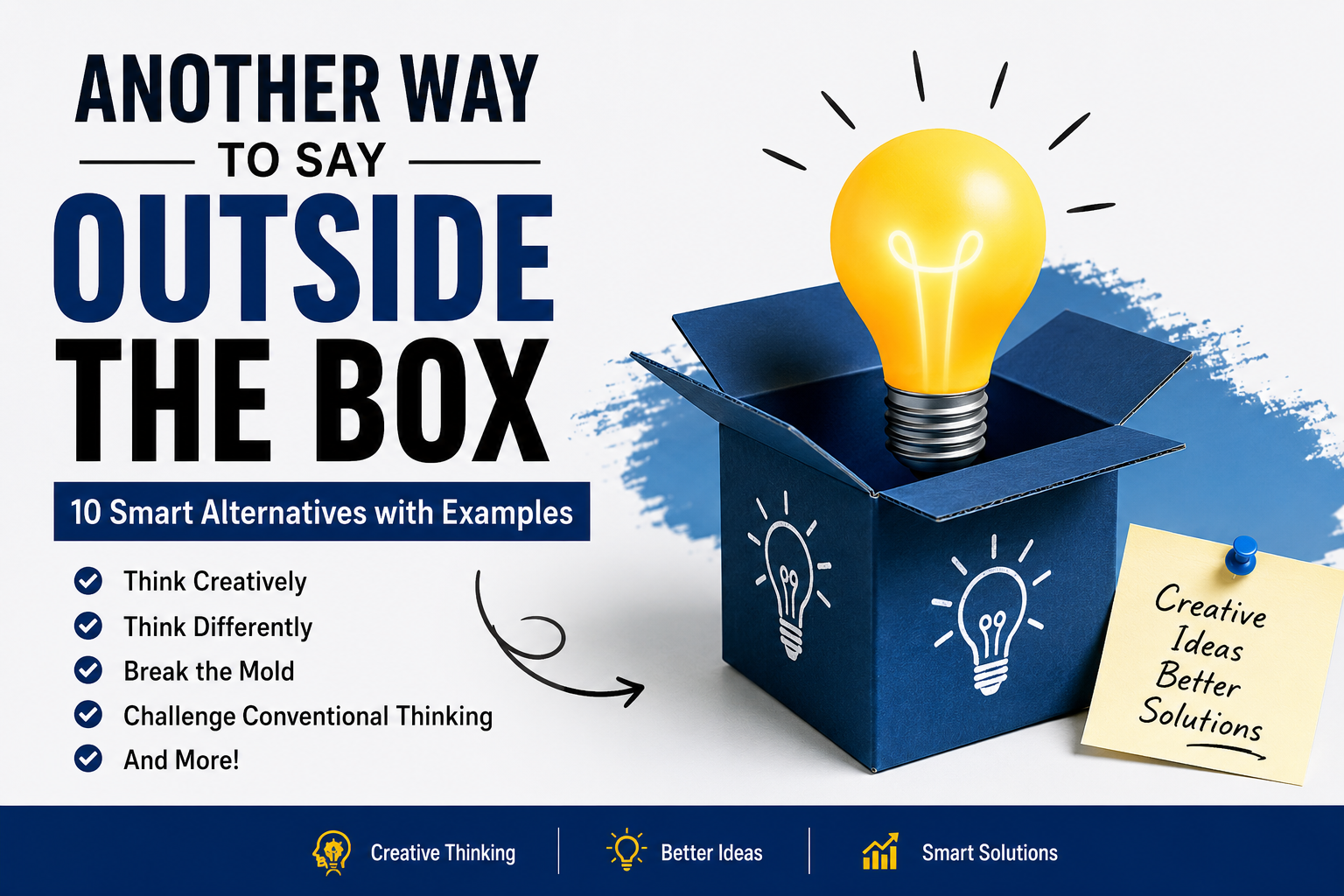
What Does “Another Way to Say Outside the Box” Mean?
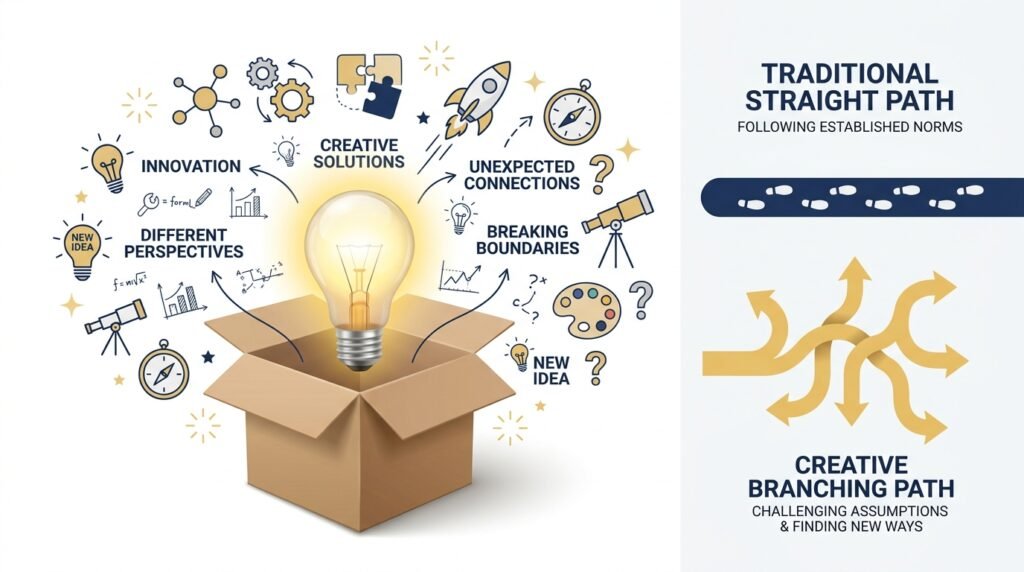
The phrase “outside the box” means thinking in a creative, unusual, or unconventional way rather than following the usual approach. Someone who thinks outside the box looks for fresh ideas and solutions instead of relying only on familiar methods.
The expression is common in business, education, marketing, problem-solving, and everyday conversation. For example, a manager might ask employees to “think outside the box” when a standard solution is not working.
People often search for another way to say “outside the box” because the expression has become very common. Replacing it with a more precise phrase can make your writing sound fresher and better suited to the situation.
Why Use Other Ways to Say “Outside the Box”?
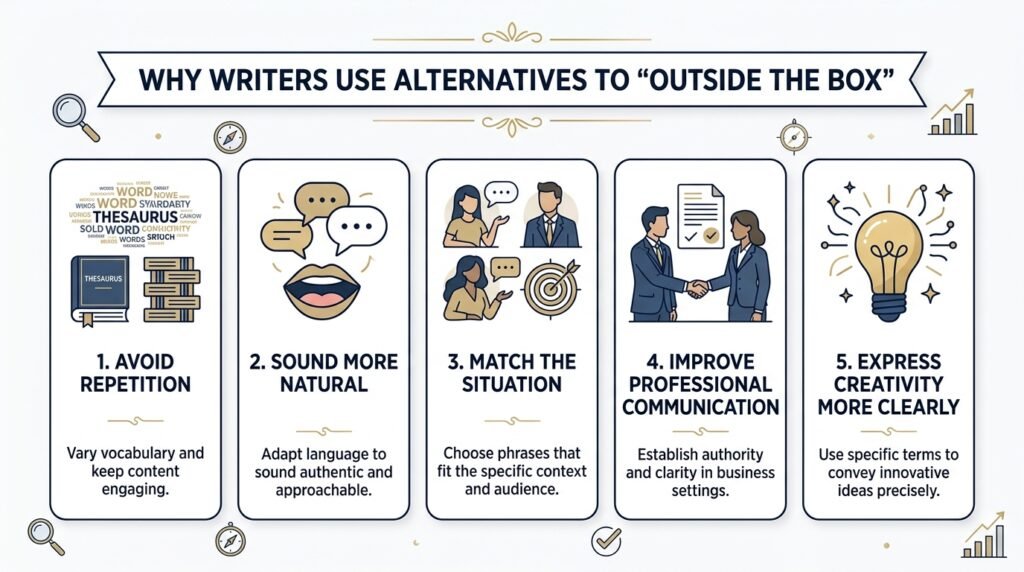
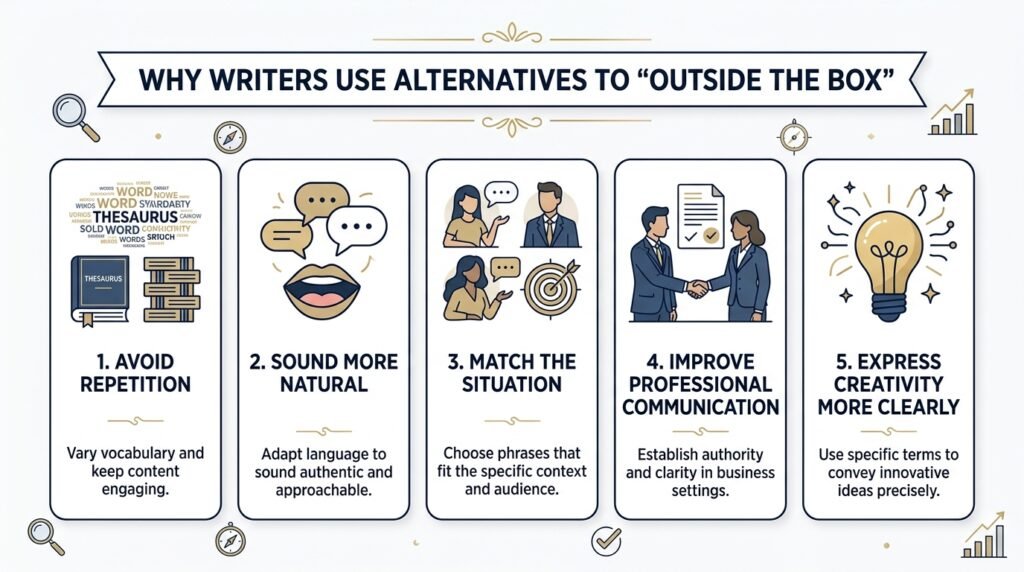
Although “outside the box” is widely understood, it can sometimes sound generic or overused. A more specific alternative can communicate exactly what you mean.
Using different expressions can help you:
- Avoid repeating the same phrase.
- Make your writing sound more natural.
- Match your language to a professional or casual setting.
- Describe creativity more precisely.
- Make business and academic writing more polished.
- Emphasize innovation, originality, or unconventional thinking.
The right alternative depends on what you want to emphasize. For example, “think creatively” focuses on creativity, while “challenge conventional thinking” emphasizes questioning established ideas.
10 Best Other Ways to Say “Outside the Box”
1. Think Creatively
Meaning
“Think creatively” means using imagination to develop new ideas or solve a problem. It is one of the most natural replacements for “think outside the box” because it is clear without sounding forced.
Best For
- Professional
- Casual
- Friendly
- Formal
Example 1
Our design team needs to think creatively to make the new product stand out.
Example 2
If the usual study method is not helping, try to think creatively about how you learn.
Quick Tip
Use this phrase when you want a simple, widely understood alternative that works in almost any setting.
2. Think Differently
Meaning
“Think differently” suggests approaching an issue from a perspective that is different from the usual one. It is short, natural, and easy to use in both speech and writing.
Best For
- Casual
- Professional
- Friendly
- Warm
Example 1
Great entrepreneurs often think differently when they face difficult problems.
Example 2
Instead of copying your competitors, try to think differently about what customers actually need.
Quick Tip
Choose this option when you want your sentence to sound conversational rather than overly formal.
3. Break the Mold
Meaning
“Break the mold” means doing something in a way that differs from the traditional or expected approach. It often suggests originality and a willingness to move away from established patterns.
Best For
- Casual
- Friendly
- Professional
Example 1
The company wants to break the mold with its new advertising campaign.
Example 2
She broke the mold by creating a classroom where students could choose how to complete their projects.
Quick Tip
Use “break the mold” when you want to emphasize boldness or a departure from tradition.
4. Challenge Conventional Thinking
Meaning
“Challenge conventional thinking” means questioning ideas, practices, or assumptions that people commonly accept. It has a more serious tone than “outside the box.”
Best For
- Professional
- Formal
Example 1
The research team was encouraged to challenge conventional thinking about renewable energy.
Example 2
Successful leaders sometimes challenge conventional thinking to find better ways to serve their customers.
Quick Tip
This phrase is especially effective in business, research, leadership, and academic writing.
5. Think Unconventionally
Meaning
“Think unconventionally” means considering ideas that do not follow normal or traditional patterns. It directly communicates the idea behind “outside the box” while sounding more precise.
Best For
- Professional
- Formal
- Academic
Example 1
The competition rewards students who think unconventionally when solving complex problems.
Example 2
Our engineers had to think unconventionally to work around the project’s limitations.
Quick Tip
Use this phrase when you want a polished alternative that clearly emphasizes unusual thinking.
6. Approach It From a Fresh Perspective
Meaning
This phrase means looking at a familiar issue from a new point of view. It focuses less on being unusual and more on finding a fresh way to understand or solve something.
Best For
- Professional
- Formal
- Polite
Example 1
Let’s approach the problem from a fresh perspective before making a final decision.
Example 2
The consultant helped the company approach its customer service strategy from a fresh perspective.
Quick Tip
This is a strong choice for professional emails, meetings, reports, and presentations.
7. Come Up With Innovative Ideas
Meaning
“Come up with innovative ideas” emphasizes creating new and useful ideas. It is particularly appropriate when discussing products, services, technology, business strategies, or creative projects.
Best For
- Professional
- Formal
- Friendly
Example 1
The marketing team needs to come up with innovative ideas for the holiday campaign.
Example 2
Students were asked to come up with innovative ideas for reducing food waste on campus.
Quick Tip
Use this phrase when the main point is producing new ideas rather than simply thinking differently.
8. Take a Nontraditional Approach
Meaning
“Take a nontraditional approach” means choosing a method that differs from the standard or expected way of doing something. It sounds professional and works especially well when describing strategies or methods.
Best For
- Professional
- Formal
Example 1
The startup took a nontraditional approach to employee training.
Example 2
The teacher decided to take a nontraditional approach to the final assignment.
Quick Tip
Use this phrase when you are describing an actual method or strategy rather than someone’s general mindset.
9. Think Beyond the Usual
Meaning
“Think beyond the usual” encourages someone to consider possibilities beyond familiar choices or standard solutions. It has a friendly and motivational tone.
Best For
- Casual
- Friendly
- Warm
- Professional
Example 1
When planning your next trip, think beyond the usual tourist destinations.
Example 2
Our team needs to think beyond the usual solutions if we want to solve this problem quickly.
Quick Tip
This phrase works well in marketing, creative writing, presentations, and motivational communication.
10. Push the Boundaries
Meaning
“Push the boundaries” means going beyond established limits or expectations. It often implies experimentation, ambition, and a willingness to explore new possibilities.
Best For
- Professional
- Casual
- Creative
- Friendly
Example 1
The filmmaker continues to push the boundaries of visual storytelling.
Example 2
This year’s design team is ready to push the boundaries and experiment with new concepts.
Quick Tip
Use this phrase when creativity involves taking risks or going beyond what is normally expected.
Comparison Table
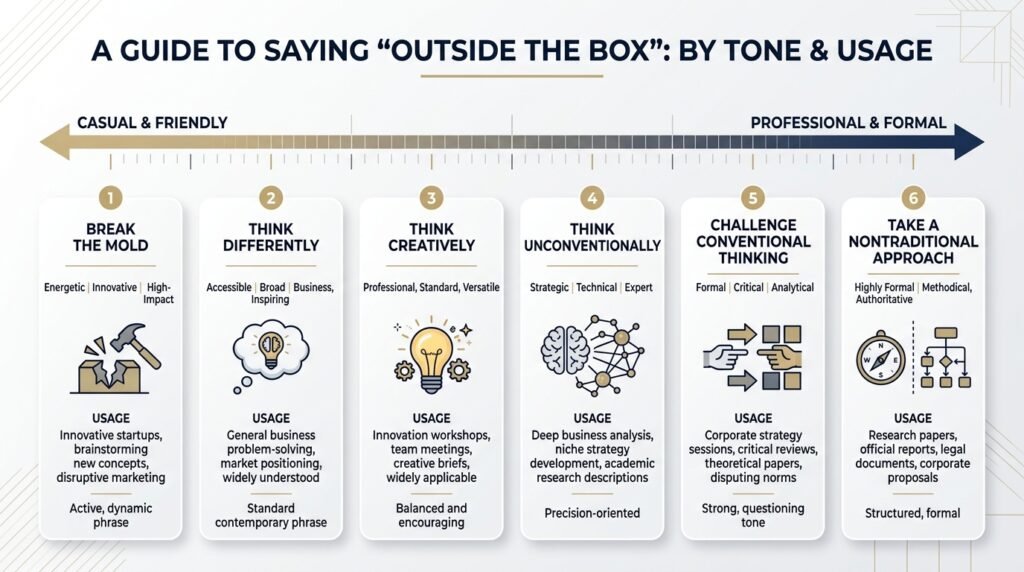
| Alternative | Best Used In | Tone |
| Think creatively | Work, school, everyday conversation | Clear and versatile |
| Think differently | Everyday and professional communication | Conversational |
| Break the mold | Creative and business settings | Bold |
| Challenge conventional thinking | Business, research, leadership | Formal and analytical |
| Think unconventionally | Professional and academic writing | Polished |
| Approach it from a fresh perspective | Emails, meetings, reports | Professional |
| Come up with innovative ideas | Business, marketing, technology | Modern and positive |
| Take a nontraditional approach | Strategies, methods, education | Formal |
| Think beyond the usual | Marketing, presentations, conversation | Friendly and motivational |
| Push the boundaries | Creative, business, and artistic settings | Bold and ambitious |
Common Mistakes
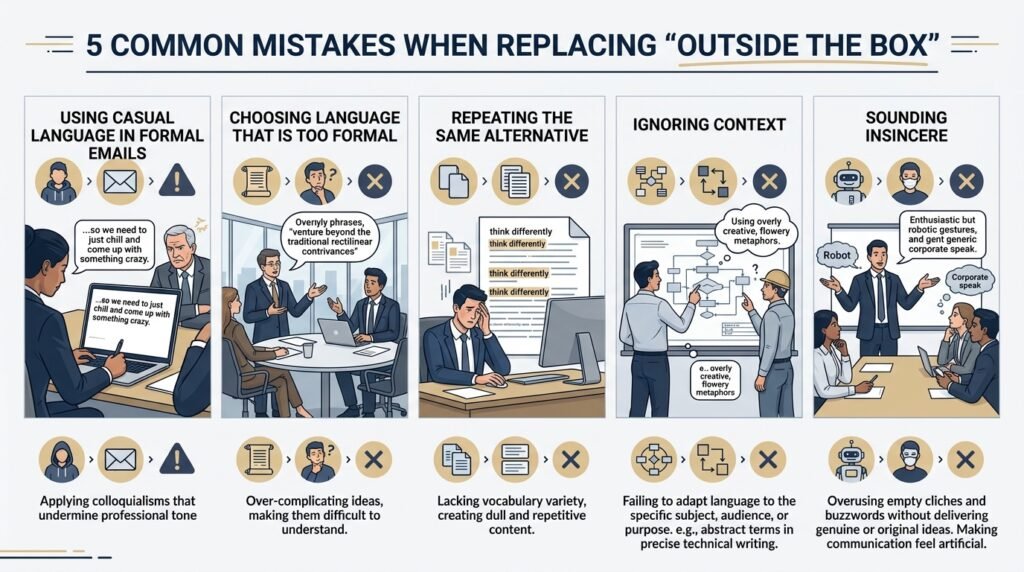
1. Using Casual Phrases in Professional Emails
Expressions such as “break the mold” can work in a friendly workplace, but they may not fit every formal email. When writing to clients or executives, “think creatively” or “take a nontraditional approach” may sound more appropriate.
2. Choosing Overly Formal Language
Not every sentence needs sophisticated wording. Replacing “outside the box” with “challenge conventional thinking” can sound unnecessarily formal in a casual conversation.
3. Repeating the Same Alternative
Simply replacing “outside the box” with “think creatively” every time does not solve the repetition problem. Rotate your wording based on the exact meaning you want to convey.
4. Forgetting the Context
Creativity, innovation, unconventional thinking, and risk-taking are related but not identical. Choose a phrase that accurately describes the person’s action or idea.
5. Making Creativity Sound Insincere
Avoid using creative language just to make an idea sound impressive. A simple phrase is often stronger when it clearly explains what someone actually did.
Frequently Asked Questions
What is another way to say “outside the box”?
Common alternatives include “think creatively,” “think differently,” “think unconventionally,” “break the mold,” and “challenge conventional thinking.” The best choice depends on your context. For general writing, “think creatively” is one of the safest options because it is natural, clear, and widely understood.
What is a professional way to say “outside the box”?
A professional alternative could be “challenge conventional thinking,” “think unconventionally,” or “take a nontraditional approach.” These expressions work well in business reports, presentations, workplace communication, and formal discussions because they sound specific without being overly casual.
What is a synonym for “thinking outside the box”?
Useful synonyms include creative thinking, innovative thinking, unconventional thinking, original thinking, and lateral thinking. Each has a slightly different meaning. “Creative thinking” is broad, while “lateral thinking” often refers to approaching a problem from an unexpected angle.
Is “think differently” the same as “think outside the box”?
The two expressions are very similar, but they are not always identical. “Think differently” simply means using a different perspective or approach. “Think outside the box” usually carries a stronger suggestion that the person is moving beyond conventional ideas or established solutions.
How do you say “outside the box” in a formal way?
For formal writing, try “challenge conventional thinking,” “think unconventionally,” or “take a nontraditional approach.” These phrases are more precise than the common idiom and can work well in academic papers, professional reports, business proposals, and formal presentations.
What is a good alternative to “think outside the box” in an email?
For most professional emails, “think creatively” is an excellent choice. For example, you could write, “Let’s think creatively about how we can address this issue.” If you want a more formal tone, “Let’s approach the issue from a fresh perspective” also works well.
What is a more positive way to say “outside the box”?
“Think creatively,” “come up with innovative ideas,” and “think beyond the usual” all have positive tones. They focus on possibilities rather than criticizing traditional methods. These expressions are especially useful when encouraging employees, students, or teams to explore new ideas.
Can “push the boundaries” replace “outside the box”?
Yes, but the meaning is slightly stronger. “Push the boundaries” suggests going beyond normal limits, expectations, or accepted practices. Use it when an idea involves experimentation, ambition, or a willingness to take creative risks rather than simply approaching a problem differently.
Conclusion
Finding another way to say “outside the box” can make your writing more precise, natural, and engaging. The best alternative depends on what you want to emphasize and who will read your words.
For everyday and professional communication, “think creatively” and “think differently” are reliable choices. If you want a more formal expression, try “challenge conventional thinking” or “take a nontraditional approach.” For bold creative work, “break the mold” and “push the boundaries” can add more energy.
The key is to choose a phrase that matches your actual meaning instead of replacing the idiom mechanically. When your wording reflects the situation, your writing sounds clearer, more confident, and more authentic.