
The phrase “made sure” means that someone took action to confirm, check, or guarantee that something happened or was correct. For example, “I made sure the door was locked” means the person checked the door so they knew it was secure.
People commonly use “made sure” in everyday conversations, emails, workplace communication, instructions, and personal writing. Because the phrase is so common, you may want a synonym to avoid repetition or make your writing more precise.
Depending on the situation, you can replace it with words such as ensured, confirmed, verified, checked, or made certain.
Why Use Other Ways to Say “Made Sure”?
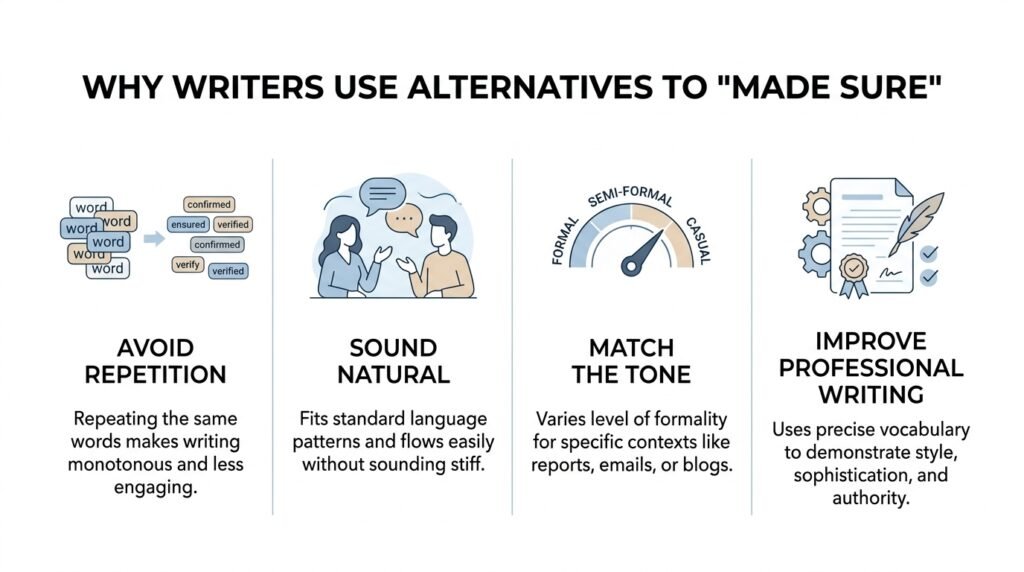
Using a different expression can make your writing more precise and natural. It can also help you match your wording to the situation.
Other alternatives can help you:
- Avoid repeating “made sure” too often.
- Sound more professional in workplace communication.
- Show a stronger sense of certainty.
- Make formal writing more concise.
- Choose a phrase that fits the exact situation.
- Make everyday conversations sound more natural.
10 Best Other Ways to Say “Made Sure”
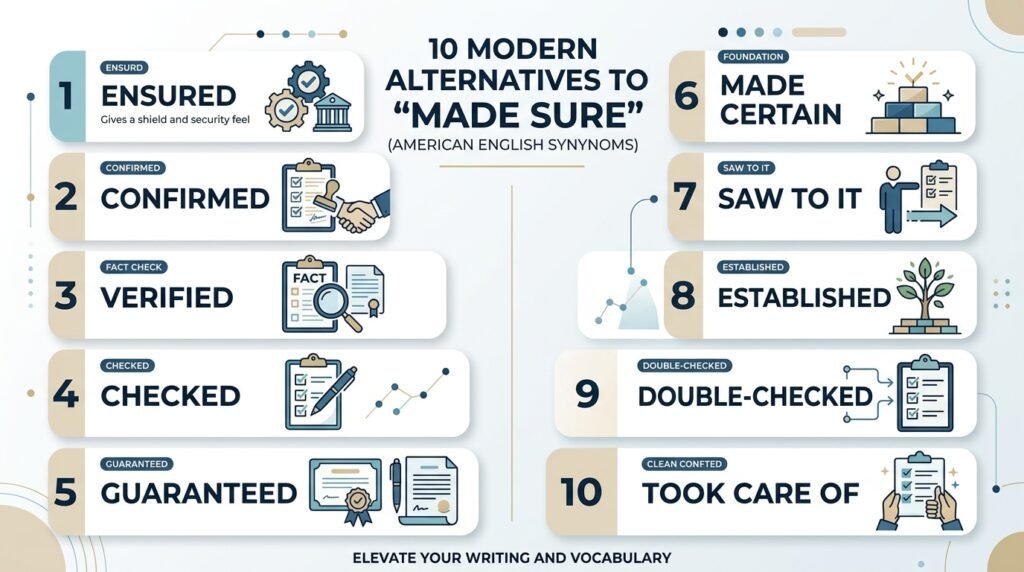
1. Ensured
Meaning
“Ensured” means you took action to make certain that something happened or was true. It is one of the strongest and most useful alternatives to “made sure,” especially in professional writing.
Best For
- Professional
- Formal
- Polite
Example 1
The manager ensured that every employee received the updated schedule.
Example 2
I ensured all the documents were ready before the meeting.
Quick Tip
Use “ensured” when you want a concise, professional replacement for “made sure.”
2. Confirmed
Meaning
“Confirmed” means you checked information and established that it was correct, true, or arranged. It works particularly well when dealing with appointments, plans, details, or facts.
Best For
- Professional
- Formal
- Polite
Example 1
I confirmed the appointment with the client this morning.
Example 2
She confirmed that the shipment would arrive on Friday.
Quick Tip
Choose “confirmed” when you are verifying information rather than actively controlling an outcome.
3. Verified
Meaning
“Verified” means you checked something carefully to establish its accuracy or authenticity. It sounds more precise than “made sure” and is common in professional, technical, and administrative settings.
Best For
- Professional
- Formal
Example 1
The accountant verified the figures before submitting the report.
Example 2
Please verify the address before sending the package.
Quick Tip
Use “verified” when accuracy, evidence, or factual correctness matters.
4. Checked
Meaning
“Checked” is a simple way to say that you looked at something to make sure it was correct, safe, or ready. It sounds natural and conversational without being overly casual.
Best For
- Casual
- Friendly
- Professional
Example 1
I checked the oven before leaving the house.
Example 2
She checked the email twice before sending it.
Quick Tip
“Checked” is a great everyday replacement when you want your sentence to sound straightforward and natural.
5. Double-Checked
Meaning
“Double-checked” means you checked something a second time to reduce the chance of an error. It suggests extra care and attention.
Best For
- Casual
- Friendly
- Professional
Example 1
I double-checked the meeting time before heading to the office.
Example 2
He double-checked the calculations before approving the invoice.
Quick Tip
Use “double-checked” when you want to emphasize that you took an additional step to avoid a mistake.
6. Made Certain
Meaning
“Made certain” has nearly the same meaning as “made sure,” but it can sound slightly more deliberate and formal. It emphasizes that someone took steps to guarantee a particular result.
Best For
- Formal
- Professional
- Polite
Example 1
The coordinator made certain that all guests had transportation.
Example 2
We made certain every safety requirement was met.
Quick Tip
“Made certain” is useful when you want to preserve the original structure of “made sure” while giving it a more polished tone.
7. Took Care to
Meaning
“Took care to” emphasizes attention, caution, and effort. It suggests that someone deliberately acted in a careful way to prevent a problem or achieve a desired result.
Best For
- Formal
- Professional
- Warm
Example 1
She took care to explain the instructions clearly to everyone.
Example 2
I took care to pack the equipment securely for the trip.
Quick Tip
Use this phrase when the person’s care or attention is an important part of the meaning.
8. Guaranteed
Meaning
“Guaranteed” means you made something certain or promised that a particular result would occur. However, it is stronger than “made sure,” so it should only be used when the situation genuinely supports that level of certainty.
Best For
- Professional
- Formal
Example 1
The technician guaranteed that the replacement part would be installed correctly.
Example 2
The organizer guaranteed every registered guest a reserved seat.
Quick Tip
Avoid “guaranteed” when you only performed a basic check because it can imply a promise or absolute certainty.
9. Saw to It
Meaning
“Saw to it” means you personally took responsibility for making sure something happened. It often suggests active involvement rather than simply checking something.
Best For
- Friendly
- Casual
- Professional
Example 1
Maria saw to it that everyone had a copy of the presentation.
Example 2
I saw to it that the customer received the updated information.
Quick Tip
Use “saw to it” when you want to emphasize that someone handled a task personally.
10. Was Careful to
Meaning
“Was careful to” shows that someone deliberately paid attention while doing something. It is especially useful when the goal was to avoid an error, misunderstanding, or unwanted result.
Best For
- Friendly
- Warm
- Professional
Example 1
He was careful to include all the necessary details in the application.
Example 2
She was careful to keep the original files in a separate folder.
Quick Tip
Choose this phrase when the person’s caution and attention matter more than simple confirmation.
Comparison Table
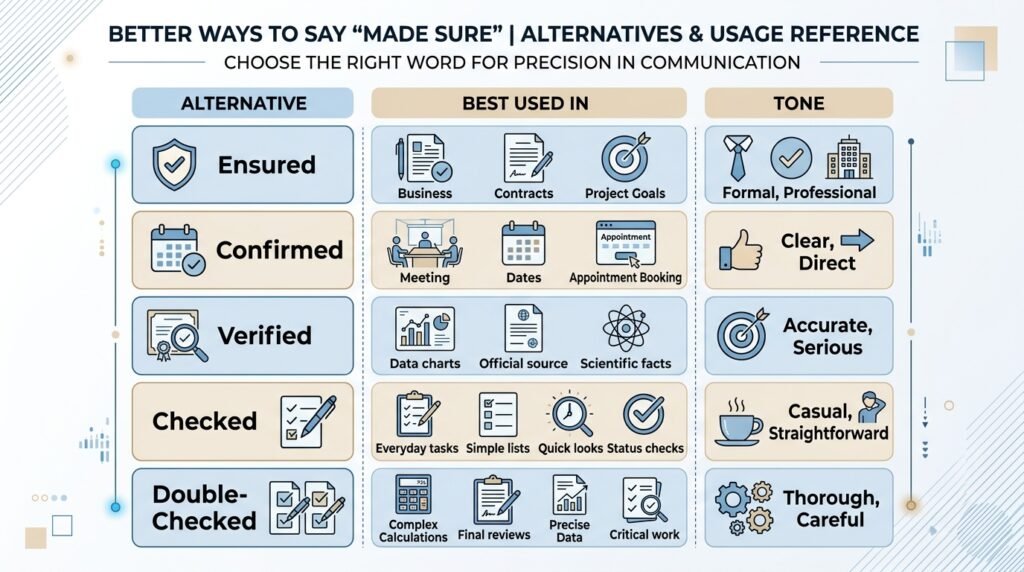
| Alternative | Best Used In | Tone |
| Ensured | Professional emails, reports, business writing | Professional |
| Confirmed | Plans, appointments, information | Professional |
| Verified | Facts, data, records, accuracy | Formal |
| Checked | Everyday conversations and tasks | Casual |
| Double-checked | Accuracy and error prevention | Careful |
| Made certain | Formal statements and polished writing | Formal |
| Took care to | Careful actions and thoughtful communication | Polite |
| Guaranteed | Promises and definite outcomes | Strong |
| Saw to it | Personal responsibility and completed tasks | Friendly |
| Was careful to | Cautious actions and detailed work | Warm |
Common Mistakes
1. Using Casual Phrases in Professional Emails
Words such as “checked” can be perfectly acceptable, but they may not always convey the level of professionalism you want. In formal reports, “ensured” or “verified” may be more appropriate.
2. Choosing Overly Formal Language
Not every sentence needs to sound like a business report. Using “verified” or “ensured” in a casual text can feel stiff when a simple “checked” would sound more natural.
3. Repeating the Same Alternative
Replacing “made sure” with “ensured” every time does not solve repetition. Rotate your wording when the context allows it, but only use a synonym when it preserves the intended meaning.
4. Forgetting Context
Not every alternative means exactly the same thing. “Confirmed” usually involves establishing information, while “took care to” emphasizes careful effort. Choose the phrase that matches the action.
5. Sounding More Certain Than You Mean
Be careful with “guaranteed.” It expresses a much stronger level of certainty than “made sure.” If you simply checked something, “verified” or “confirmed” may be more accurate.
Frequently Asked Questions
What is another way to say “made sure”?
Common alternatives include ensured, confirmed, verified, checked, double-checked, made certain, took care to, guaranteed, saw to it, and was careful to. The best choice depends on context. “Ensured” works especially well in professional writing, while “checked” sounds more natural in casual conversation.
What is a professional way to say “made sure”?
“Ensured” is usually the best professional alternative to “made sure.” For example, instead of saying “We made sure the report was accurate,” you can write, “We ensured the report was accurate.” It is concise, polished, and appropriate for business emails, reports, and workplace communication.
Is “ensured” the same as “made sure”?
In many situations, yes. Both expressions describe taking action to make certain that something happens or is correct. However, “ensured” sounds more formal and concise, while “made sure” is more conversational and common in everyday American English.
What is a simple synonym for “made sure”?
“Checked” is one of the simplest alternatives. It works when you mean that you looked at something to confirm that it was correct, safe, or ready. For example, “I checked the door” can replace “I made sure the door was locked,” depending on the exact meaning.
How can I say “I made sure” in a formal email?
In a formal email, you can usually use “I ensured,” “I confirmed,” or “I verified.” The correct choice depends on your action. Use “ensured” for making an outcome happen, “confirmed” for checking information, and “verified” when establishing accuracy.
What is another way to say “made sure everything was okay”?
You could say “confirmed that everything was okay,” “checked that everything was okay,” or “verified that everything was in order.” “Checked” sounds natural in conversation, while “verified” and “confirmed” are better suited to professional or formal situations.
Can I use “made certain” instead of “made sure”?
Yes. “Made certain” is a direct alternative and has almost the same meaning. It can sound slightly more formal or deliberate, making it useful in polished writing. For example, “She made certain that everyone understood the instructions” is a natural substitute for “She made sure everyone understood the instructions.”
What is the difference between “confirmed” and “verified”?
“Confirmed” usually means establishing that information, plans, or arrangements are correct or true. “Verified” often suggests a more careful check, especially when accuracy or evidence matters. For example, you might confirm an appointment but verify a customer’s identification or financial records.
Conclusion
Finding another way to say “made sure” can make your writing clearer, more precise, and better suited to the situation. The best alternative depends on what you actually did and how formal you want to sound.
For professional writing, “ensured” is often the strongest all-purpose choice. Use “confirmed” when checking plans or information, “verified” when accuracy matters, and “checked” for simple everyday situations. If you want to emphasize extra care, “double-checked” or “took care to” works well.
The key is not to replace “made sure” just for the sake of using a synonym. Choose the expression that accurately communicates your action, level of certainty, and intended tone. That small adjustment can make your writing sound much more natural.