

The phrase “able to” is common in American English, but using the same wording repeatedly can make your writing sound predictable. Choosing a more precise alternative can help you describe skills, opportunities, qualifications, or circumstances more clearly.
Whether you’re writing an email, resume, academic sentence, business document, or casual message, the right synonym depends on what you mean by “able to.”
What Does “Another Way to Say Able To” Mean?
Looking for another way to say “able to” means searching for a different word or phrase that expresses the same basic idea: having the skill, capacity, opportunity, or possibility to do something.
For example, “She is able to solve complex problems” could become “She can solve complex problems” or “She is capable of solving complex problems.”
People commonly look for alternatives to “able to” when they want to avoid repetition, improve professional writing, or make a sentence sound more natural. The phrase appears frequently in resumes, emails, essays, reports, workplace communication, and everyday conversation.
Why Use Other Ways to Say “Able To”?
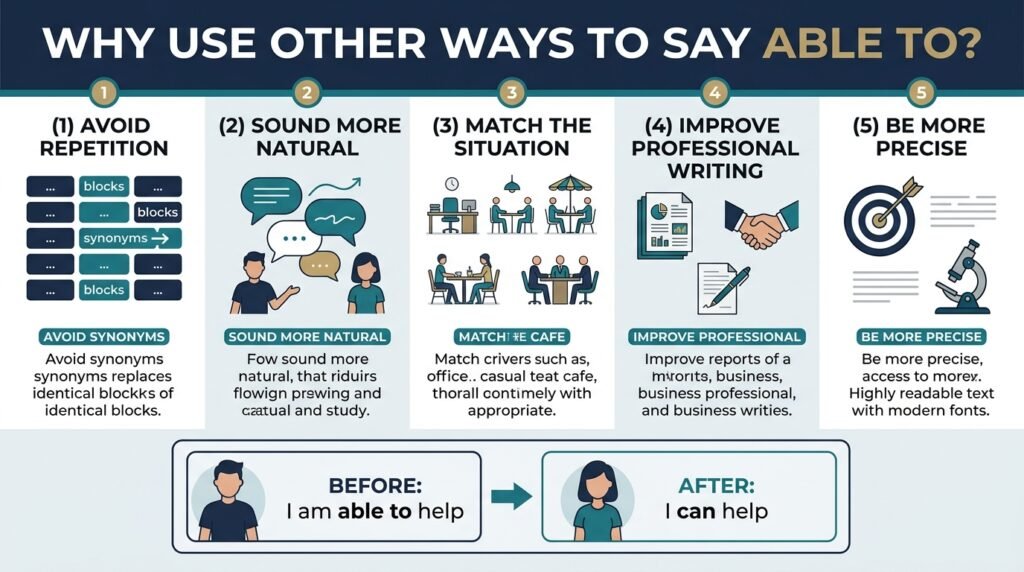
Using alternatives can make your writing more specific and natural. However, a synonym is not always interchangeable with “able to,” so consider the exact meaning before replacing it.
Other options can help you:
- Avoid repeating the same phrase.
- Make sentences shorter and clearer.
- Highlight a person’s skills or qualifications.
- Describe a specific opportunity or circumstance.
- Create a more professional tone.
- Make everyday conversation sound more natural.
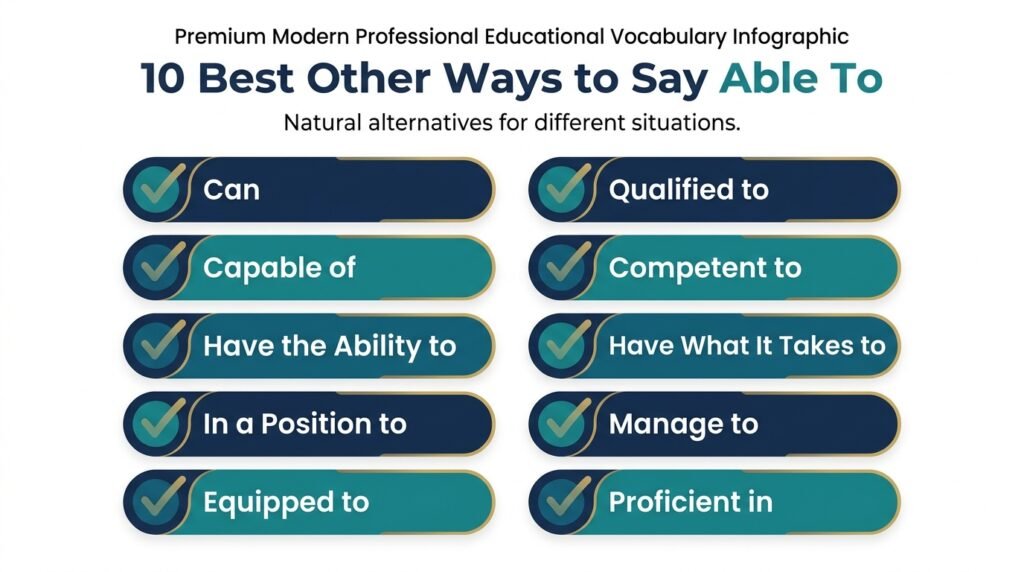
10 Best Other Ways to Say “Able To”
1. Can
Meaning
“Can” is the most natural and common alternative to “able to” when talking about someone’s ability or possibility. In many everyday sentences, it sounds simpler and less wordy than “able to.”
Best For
- Casual
- Friendly
- Professional
- Polite
Example 1
I can finish the report before the meeting tomorrow.
Example 2
Our customer support team can answer questions seven days a week.
Quick Tip
Use “can” when you want a short, direct sentence. It is often the best replacement in everyday American English.
2. Capable Of
Meaning
“Capable of” emphasizes a person’s or thing’s ability, skill, or potential to perform an action. It often sounds stronger and more descriptive than simply saying “able to.”
Best For
- Professional
- Formal
Example 1
Maria is capable of handling several projects at the same time.
Example 2
This software is capable of processing thousands of transactions per minute.
Quick Tip
Use “capable of” when you want to emphasize competence or capacity rather than simply state that something is possible.
3. Have the Ability to
Meaning
“Have the ability to” directly describes someone’s capacity or skill. It is especially useful when discussing professional qualifications, performance, or specific capabilities.
Best For
- Professional
- Formal
Example 1
The new manager has the ability to motivate employees during difficult projects.
Example 2
Modern cameras have the ability to capture detailed images in low light.
Quick Tip
This phrase works well in professional and academic writing, but don’t overuse it because “can” is usually more concise.
4. In a Position to
Meaning
“In a position to” means that someone has the circumstances, authority, resources, or opportunity needed to do something. It focuses more on a situation than on natural ability.
Best For
- Professional
- Formal
- Polite
Example 1
We are now in a position to offer our customers faster delivery.
Example 2
After reviewing the proposal, the committee is in a position to approve the project.
Quick Tip
Choose this phrase when someone’s circumstances or authority make an action possible.
5. Equipped to
Meaning
“Equipped to” suggests that someone has the tools, knowledge, training, resources, or preparation needed to complete a task. It is particularly useful in workplace and technical contexts.
Best For
- Professional
- Formal
Example 1
The technicians are equipped to handle complex network problems.
Example 2
Our training program prepares graduates who are equipped to enter the modern workforce.
Quick Tip
Use “equipped to” when the ability comes from preparation, resources, equipment, or training.
6. Qualified to
Meaning
“Qualified to” means someone has the required training, credentials, knowledge, or experience to perform a particular task. It refers to formal suitability rather than general ability.
Best For
- Professional
- Formal
Example 1
Only licensed professionals are qualified to perform the inspection.
Example 2
After completing the certification, James became qualified to teach the course.
Quick Tip
Use this phrase when qualifications, licenses, certifications, or professional standards matter.
7. Competent To
Meaning
“Competent to” indicates that someone has enough skill, knowledge, or judgment to perform a task successfully. It can sound more formal than “can” and is common in professional contexts.
Best For
- Professional
- Formal
Example 1
The new employee is competent to manage the account independently.
Example 2
The engineer is competent to assess the structural design.
Quick Tip
Use “competent to” when you want to emphasize reliable skill or sufficient knowledge.
8. Have What It Takes To
Meaning
“Have what it takes to” is an idiomatic way to say that someone has the qualities, determination, skills, or confidence needed to succeed. It is more expressive than the neutral “able to.”
Best For
- Casual
- Friendly
- Warm
Example 1
I believe you have what it takes to lead this team.
Example 2
She has the creativity and persistence to have what it takes to build a successful business.
Quick Tip
This phrase works especially well when encouraging someone or talking about potential, ambition, and determination.
9. Manage To
Meaning
“Manage to” means succeeding in doing something, often despite difficulty, limited time, or unexpected problems. It does not simply mean having the ability to do something.
Best For
- Casual
- Friendly
- Professional
Example 1
Despite the delay, we managed to complete the installation before sunset.
Example 2
He managed to find an affordable apartment near his new office.
Quick Tip
Use “manage to” when the action required effort or overcoming some kind of challenge.
10. Proficient In
Meaning
“Proficient in” describes a high level of skill or competence in a particular subject, tool, language, or activity. It is not a direct replacement in every sentence, but it can communicate ability more precisely.
Best For
- Professional
- Formal
Example 1
She is proficient in Adobe Photoshop and Illustrator.
Example 2
The candidate is proficient in several programming languages.
Quick Tip
Use “proficient in” when discussing established skills, especially on resumes, applications, and professional profiles.
Comparison Table
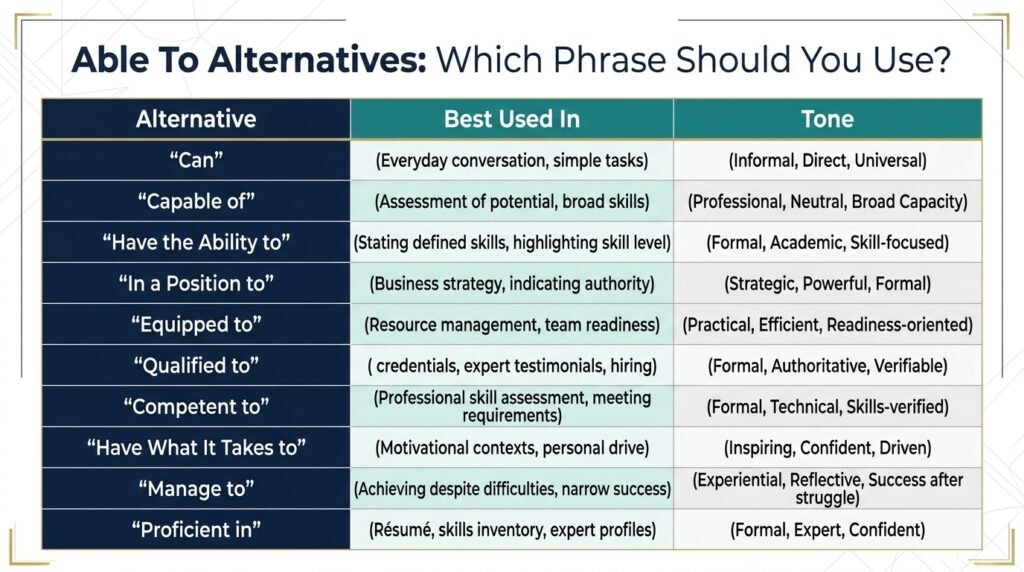
| Alternative | Best Used In | Tone |
| Can | Everyday conversations and general writing | Natural |
| Capable of | Skills and capacity | Professional |
| Have the ability to | Formal explanations | Formal |
| In a position to | Opportunities and authority | Professional |
| Equipped to | Training, tools, and preparation | Professional |
| Qualified to | Credentials and professional requirements | Formal |
| Competent to | Skill and reliable performance | Formal |
| Have what it takes to | Potential and encouragement | Warm |
| Manage to | Success despite difficulty | Conversational |
| Proficient in | Established skills and expertise | Professional |
Common Mistakes
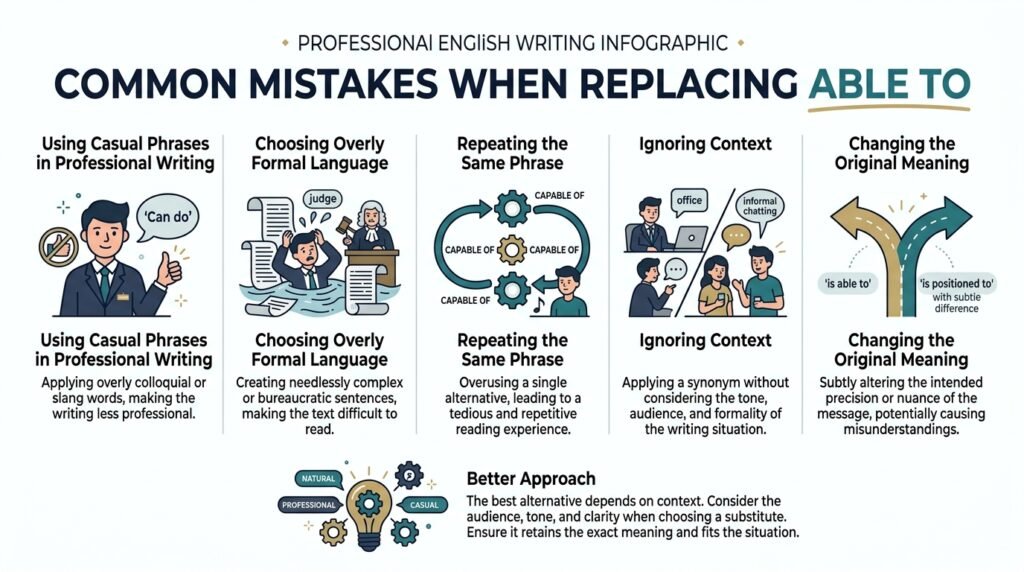
1. Using a Casual Phrase in a Professional Context
Phrases such as “have what it takes to” can sound encouraging and friendly, but they may not fit a formal report. Choose “qualified to,” “capable of,” or another precise option when writing professionally.
2. Choosing an Overly Formal Alternative
Not every sentence needs sophisticated vocabulary. Replacing “I can help” with “I have the ability to assist” may make a simple message unnecessarily wordy.
3. Repeating the Same Phrase
Using “able to” several times in the same paragraph can make your writing feel repetitive. Look for opportunities to use “can,” “capable of,” or a more precise phrase.
4. Ignoring the Context
Not all alternatives have exactly the same meaning. “Qualified to” refers to credentials, while “manage to” suggests successful completion despite difficulty.
5. Using a Synonym That Changes the Meaning
A replacement should preserve the original idea. For example, “She was able to finish the work” and “She managed to finish the work” are similar, but the second sentence suggests that finishing may have been difficult.
Frequently Asked Questions
What is the simplest way to say “able to”?
The simplest alternative to “able to” is usually “can.” For example, “I am able to help you” becomes “I can help you.” This version is shorter, natural, and appropriate for most everyday conversations and general writing.
What is a professional way to say “able to”?
Professional alternatives include “capable of,” “qualified to,” “equipped to,” and “have the ability to.” The best choice depends on your meaning. “Capable of” emphasizes skill, while “qualified to” highlights credentials or professional requirements.
Is “can” the same as “able to”?
In many situations, “can” and “able to” have the same basic meaning. However, “able to” can sometimes emphasize a particular situation or achievement. For example, “I was able to solve the problem” can suggest that you successfully completed something that may have been difficult.
What is another way to say “able to do”?
You can say “can do,” “capable of doing,” “have the ability to do,” “equipped to do,” or “in a position to do.” The right option depends on whether you want to emphasize ability, preparation, opportunity, or circumstances.
What is a formal synonym for “able to”?
“Capable of,” “qualified to,” “competent to,” and “have the ability to” are useful formal alternatives. However, formal writing does not always require a longer phrase. In many cases, “can” remains the clearest and most professional choice.
What is another way to say “able to” on a resume?
On a resume, use specific skill language instead of repeatedly writing “able to.” For example, replace “able to manage projects” with “proficient in project management” or “experienced in managing projects.” Specific wording gives employers clearer information about your skills.
What is a better way to say “I am able to”?
The best alternative depends on the sentence. “I can” is usually the most natural choice. In professional writing, you might use “I am qualified to,” “I am capable of,” or “I am equipped to” when those phrases accurately describe your experience or preparation.
Is “manage to” a synonym for “able to”?
“Manage to” can sometimes replace “able to,” but the meanings are not identical. “Manage to” suggests that someone succeeded despite difficulty, effort, or an obstacle. If there was no challenge involved, “can” or “able to” may be more accurate.
Conclusion
Finding another way to say “able to” can make your writing more natural, precise, and effective. The best alternative depends on what you want to emphasize and who will read your sentence.
For everyday communication, “can” is usually the clearest choice. Use “capable of” when you want to highlight ability or capacity, “qualified to” when credentials matter, and “equipped to” when training or resources are important. If success involved difficulty, “manage to” may communicate the situation better.
The key is not to replace “able to” simply for the sake of variety. Choose the phrase that accurately expresses your intended meaning, fits the tone, and keeps your sentence easy to understand.