

“Talk to you tomorrow” is a common way to end a conversation when you expect to speak with someone again the next day. It sounds friendly, relaxed, and natural in texts, phone calls, emails, and everyday conversations.
However, repeating the same closing can make your communication feel predictable. Choosing a different phrase can help you match the tone of the situation while keeping your message natural.
What Does “Another Way to Say Talk to You Tomorrow” Mean?

The phrase “another way to say talk to you tomorrow” refers to alternative expressions that communicate the same basic idea: you expect to communicate with someone again tomorrow.
“Talk to you tomorrow” is usually casual and friendly. People commonly use it with friends, coworkers, family members, classmates, clients, or anyone they expect to contact the following day.
For example, you might say, “Thanks for your help today. Talk to you tomorrow!” after finishing a conversation with a coworker.
The alternative you choose can change the tone slightly. “See you tomorrow” sounds casual, while “I’ll be in touch tomorrow” feels more professional.
Why Use Other Ways to Say “Talk to You Tomorrow”?
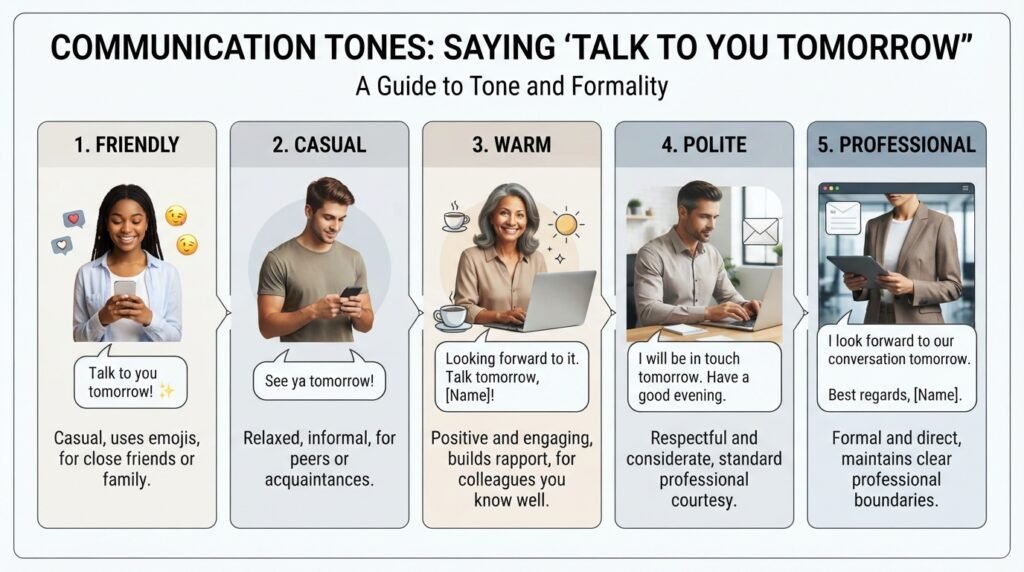
Using different expressions can make your communication more flexible and appropriate for different situations.
Here are a few reasons to use alternatives:
- Avoid repetition: Keep your conversations from sounding formulaic.
- Sound more natural: Choose wording that fits the specific situation.
- Match the setting: Use professional language at work and relaxed language with friends.
- Show warmth: Some alternatives feel more personal or friendly.
- Be more precise: Make it clear whether you mean a meeting, call, message, or general contact.
10 Best Other Ways to Say “Talk to You Tomorrow”
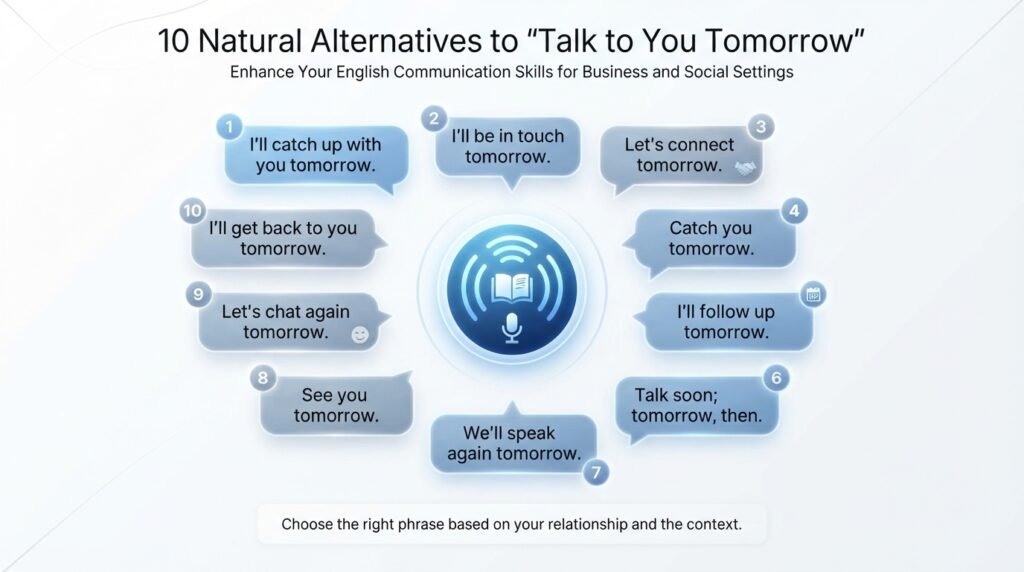
1. See You Tomorrow
Meaning
“See you tomorrow” is one of the most natural alternatives to “talk to you tomorrow.” Although it literally suggests seeing someone in person, Americans also use it casually when they simply expect to interact with someone again the next day.
Best For
- Casual
- Friendly
- Warm
Example 1
“Thanks for helping me finish this project. See you tomorrow!”
Example 2
“I’m heading home now. See you tomorrow at the office.”
Quick Tip
Use this phrase when you already know you will meet or interact with the person tomorrow.
2. Speak With You Tomorrow
Meaning
“Speak with you tomorrow” is a slightly more polished version of “talk to you tomorrow.” It works especially well when you are ending a professional phone call, meeting, or work-related conversation.
Best For
- Professional
- Formal
- Polite
Example 1
“I’ll review the numbers tonight and speak with you tomorrow.”
Example 2
“Thank you for taking the time to discuss the proposal. I’ll speak with you tomorrow.”
Quick Tip
Choose “speak with you tomorrow” when “talk to you tomorrow” feels too casual for the situation.
3. I’ll Talk to You Tomorrow
Meaning
“I’ll talk to you tomorrow” keeps the original idea but turns it into a complete sentence. It can sound a little more deliberate and reassuring than the shorter “talk to you tomorrow.”
Best For
- Casual
- Friendly
- Warm
Example 1
“I need to get some sleep, but I’ll talk to you tomorrow.”
Example 2
“Let me think about your suggestion, and I’ll talk to you tomorrow.”
Quick Tip
Use this version when you want to emphasize that you plan to contact the person again.
4. I’ll Catch Up With You Tomorrow
Meaning
“I’ll catch up with you tomorrow” suggests that you plan to reconnect and continue a conversation. It feels relaxed and personable, making it a good choice for friends, coworkers, and familiar contacts.
Best For
- Casual
- Friendly
- Warm
Example 1
“We have a lot to discuss, so I’ll catch up with you tomorrow.”
Example 2
“I’m running late tonight, but I’ll catch up with you tomorrow.”
Quick Tip
Use this expression when you want to suggest reconnecting rather than simply exchanging a few words.
5. I’ll Be in Touch Tomorrow
Meaning
“I’ll be in touch tomorrow” means you intend to contact the person again the following day. It sounds professional and is especially useful when the exact method of communication does not matter.
Best For
- Professional
- Formal
- Polite
Example 1
“I’ll review your application and be in touch tomorrow.”
Example 2
“Thanks for sending the documents. I’ll be in touch tomorrow with an update.”
Quick Tip
This is a strong choice for business emails, clients, customers, and professional follow-ups.
6. Until Tomorrow
Meaning
“Until tomorrow” is a brief and somewhat warmer way to indicate that you expect to see or communicate with someone the next day. It has a slightly more polished feel than “talk to you tomorrow.”
Best For
- Friendly
- Warm
- Formal
Example 1
“Have a great evening, and until tomorrow.”
Example 2
“We’ll continue the discussion in the morning. Until tomorrow!”
Quick Tip
Use it as a short closing when the next interaction is already understood.
7. I’ll Connect With You Tomorrow
Meaning
“I’ll connect with you tomorrow” emphasizes future communication rather than a specific type of conversation. It works well in workplace settings, especially when you may communicate by phone, video call, email, or messaging.
Best For
- Professional
- Polite
- Formal
Example 1
“I’ll connect with you tomorrow to go over the final details.”
Example 2
“Once I receive the report, I’ll connect with you tomorrow.”
Quick Tip
This phrase is useful when you want to keep the communication method flexible.
8. Let’s Continue Tomorrow
Meaning
“Let’s continue tomorrow” tells the other person that you want to resume the current conversation or activity the next day. It works particularly well when a discussion is unfinished.
Best For
- Professional
- Casual
- Friendly
Example 1
“We’ve covered the main points, so let’s continue tomorrow.”
Example 2
“It’s getting late, and we still have a few questions. Let’s continue tomorrow.”
Quick Tip
Use this when you are deliberately pausing an ongoing discussion rather than simply saying goodbye.
9. I’ll Check In With You Tomorrow
Meaning
“I’ll check in with you tomorrow” suggests that you plan to contact someone to see how things are going or provide an update. It often sounds considerate and attentive.
Best For
- Professional
- Friendly
- Warm
- Polite
Example 1
“I’ll check in with you tomorrow to see how the project is going.”
Example 2
“Get some rest tonight, and I’ll check in with you tomorrow.”
Quick Tip
Choose this phrase when your future conversation has a specific purpose, such as an update or follow-up.
10. We’ll Talk Tomorrow
Meaning
“We’ll talk tomorrow” is direct, simple, and conversational. It indicates that both people expect another conversation the following day without making the statement overly formal.
Best For
- Casual
- Friendly
- Warm
Example 1
“Don’t worry about it tonight. We’ll talk tomorrow.”
Example 2
“I have to finish a few things now, but we’ll talk tomorrow.”
Quick Tip
Use it with people you already have an established relationship with because it assumes another conversation is expected.
Comparison Table
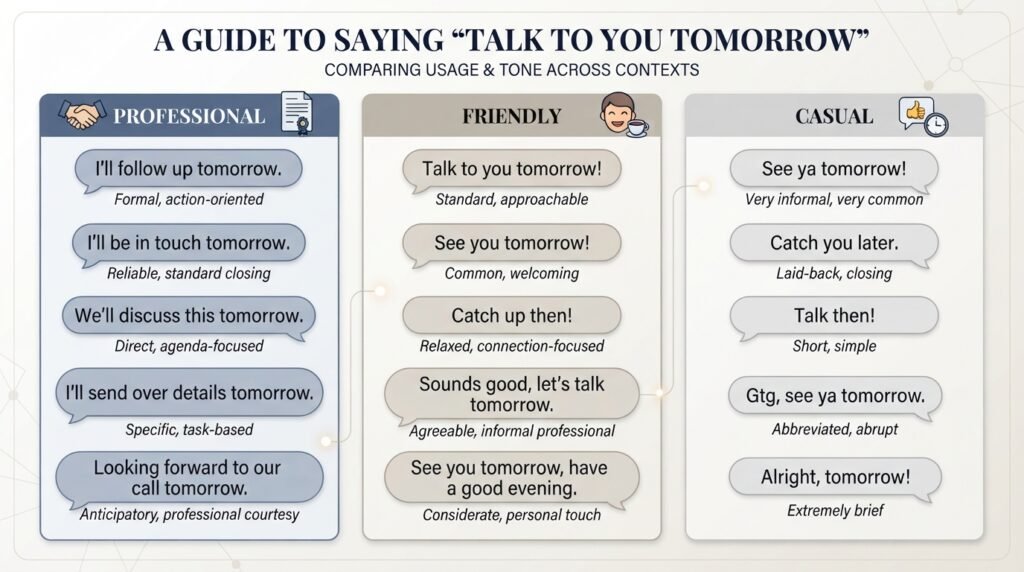
| Alternative | Best Used In | Tone |
| See you tomorrow | Everyday conversations | Casual, friendly |
| Speak with you tomorrow | Work and professional conversations | Professional, polite |
| I’ll talk to you tomorrow | Personal conversations | Friendly, warm |
| I’ll catch up with you tomorrow | Friends and familiar coworkers | Casual, warm |
| I’ll be in touch tomorrow | Emails and business follow-ups | Professional, formal |
| Until tomorrow | Short closings | Warm, polished |
| I’ll connect with you tomorrow | Workplace communication | Professional, polite |
| Let’s continue tomorrow | Ongoing discussions | Direct, friendly |
| I’ll check in with you tomorrow | Follow-ups and updates | Warm, professional |
| We’ll talk tomorrow | Familiar relationships | Casual, friendly |
Common Mistakes

1. Using Casual Phrases in Professional Emails
“Talk to you tomorrow” is perfectly natural, but it may not be the best choice for every business situation. For clients or formal correspondence, “I’ll be in touch tomorrow” can sound more polished.
2. Choosing Overly Formal Language
Not every conversation requires sophisticated wording. Saying “Until tomorrow” to a close friend may sound unnecessarily formal if “See you tomorrow” feels more natural.
3. Ignoring the Type of Future Contact
Some phrases suggest a specific purpose. “I’ll check in with you tomorrow” implies a follow-up, while “see you tomorrow” can imply an in-person meeting.
4. Repeating the Same Closing
Using “talk to you tomorrow” after every conversation can make your communication sound repetitive. Rotating between natural alternatives helps your language feel less predictable.
5. Sounding Insincere
A phrase should match what you actually intend to do. If you have no plan to contact someone tomorrow, avoid saying “I’ll call you tomorrow” simply to end a conversation politely.
Frequently Asked Questions
What is the most natural way to say “talk to you tomorrow”?
The most natural alternative in everyday American English is “see you tomorrow.” It is short, friendly, and widely understood. If you will not actually see the person in person, “I’ll talk to you tomorrow” or “we’ll talk tomorrow” may be more precise.
What is a professional way to say “talk to you tomorrow”?
“I’ll be in touch tomorrow” is one of the best professional alternatives. It works well in emails, client conversations, and workplace communication. “I’ll speak with you tomorrow” is another good choice when you specifically expect to have a conversation.
Is “see you tomorrow” the same as “talk to you tomorrow”?
They have similar meanings, but there is a small difference. “See you tomorrow” traditionally suggests meeting in person, while “talk to you tomorrow” focuses on communicating. However, casual American English often uses “see you” broadly for future interaction.
How do you say “talk to you tomorrow” in a friendly way?
You can say “see you tomorrow,” “I’ll catch up with you tomorrow,” or “we’ll talk tomorrow.” “I’ll catch up with you tomorrow” sounds especially friendly because it suggests that you look forward to reconnecting and continuing your conversation.
Can I use “I’ll be in touch tomorrow” in an email?
Yes. “I’ll be in touch tomorrow” is appropriate for professional emails and follow-ups. It is especially useful when you want to promise future contact without specifying whether you will call, email, message, or schedule a meeting.
What is a warm way to say “talk to you tomorrow”?
For a warm and personal tone, try “I’ll catch up with you tomorrow” or “I’ll check in with you tomorrow.” The first sounds relaxed and conversational, while the second can show that you genuinely care about how things are going.
Is “until tomorrow” a good alternative?
Yes, although it is less common in everyday American conversation than “see you tomorrow.” “Until tomorrow” has a slightly polished or literary feel, so it can work nicely in a warm message but may sound more formal than necessary in casual texting.
What should I say instead of “talk to you tomorrow” in a text?
For a casual text, “see you tomorrow,” “talk tomorrow,” “we’ll talk tomorrow,” or “catch up tomorrow” can work well. Choose based on your relationship with the person. With a close friend, a short phrase often sounds more natural than a formal closing.
Conclusion
Knowing another way to say “talk to you tomorrow” gives you more flexibility in everyday and professional communication. The best alternative depends on whether you are ending a casual conversation, sending a work email, or promising to follow up.
The key is to match your words to the situation. A natural phrase should communicate your intention clearly while sounding comfortable for the relationship and setting. This is especially important in professional communication.

Amara Reyes has taught English to adult learners for over eight years. She focuses on how phrases are actually used in everyday conversation, not just textbook definitions.