
When someone says something kind, positive, or complimentary, you may want to return the sentiment without repeating their exact words. Finding another way to say right back at you can help your response sound more natural and better suited to the situation.
Whether you are talking with a friend, responding to a coworker, or writing a professional message, there are many alternatives. Below are 10 useful options, along with meanings, examples, and tips for using each one naturally.
What Does “Right Back at You” Mean?

“Right back at you” means I feel the same way about you or I wish the same thing for you. It is commonly used as a response to a compliment, kind wish, or positive statement.
For example, if someone says, “You’re amazing,” you might reply, “Right back at you!” The phrase returns the same positive feeling to the other person.
People often use it in friendly, casual conversations. It is especially common among friends, family members, coworkers, and people who already have a comfortable relationship.
Why Use Other Ways to Say “Right Back at You”?
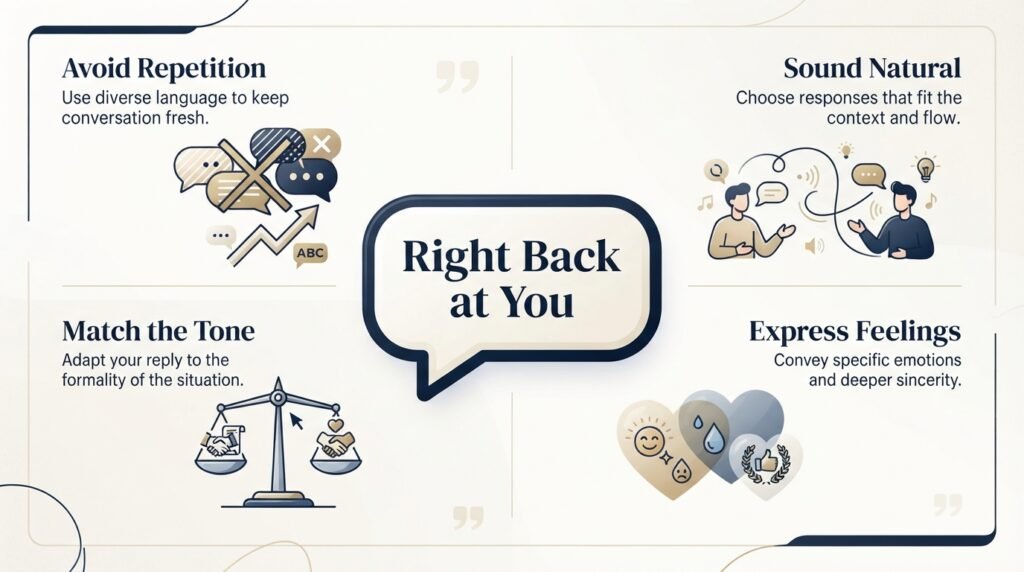
Using different expressions can make your conversations sound more natural and less repetitive. The best phrase can also help you match the situation and communicate the right level of warmth or professionalism.
Other benefits include:
- Avoiding repetitive language
- Matching casual or professional situations
- Making compliments sound more genuine
- Expressing appreciation more naturally
- Showing warmth without sounding overly formal
10 Best Other Ways to Say “Right Back at You”
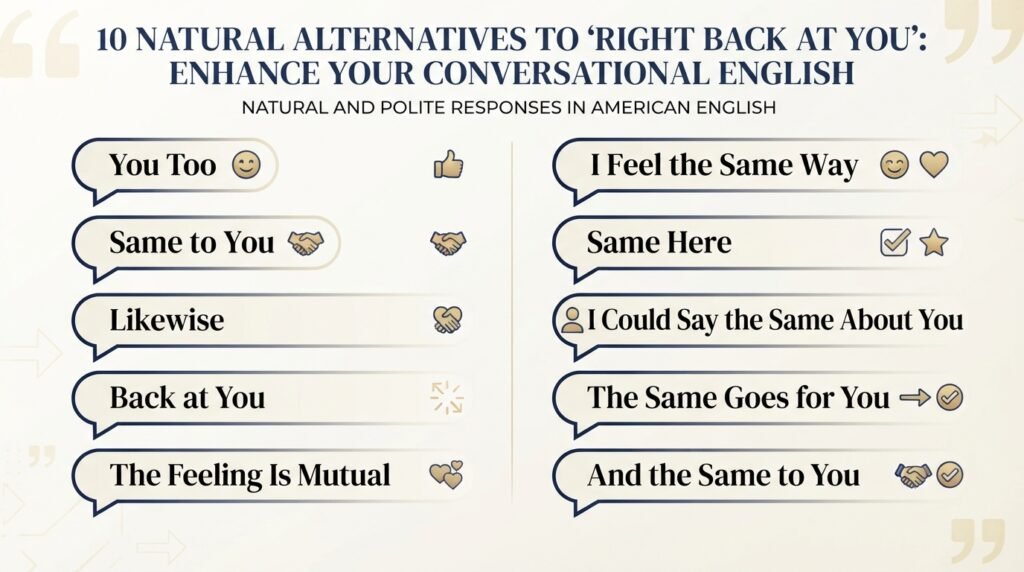
1. You Too
Meaning
“You too” is one of the simplest alternatives to “right back at you.” It is commonly used to return a wish, compliment, or kind statement.
It works because it is short, clear, and natural in everyday American English.
Best For
Casual, Friendly, Polite
Example 1
“Have a great weekend!” “You too!”
Example 2
“You did an awesome job today.” “Thanks—you too!”
Quick Tip
Use “you too” when you want a quick and natural response without making the conversation feel overly formal.
2. Same to You
Meaning
“Same to you” means that you are returning the same wish or positive feeling to the speaker. It sounds slightly more complete than simply saying “you too.”
This phrase works especially well when someone wishes you something positive.
Best For
Friendly, Warm, Polite
Example 1
“I hope you have a wonderful day.” “Same to you!”
Example 2
“Good luck with your presentation.” “Thanks, and same to you!”
Quick Tip
“Same to you” is especially useful after wishes such as “Have a great day” or “Good luck.”
3. Likewise
Meaning
“Likewise” means the same to you or I feel the same way. It is a polished alternative that can work in both personal and professional conversations.
Because it sounds more refined, it is often useful when you want to remain friendly while keeping a professional tone.
Best For
Professional, Formal, Polite
Example 1
“It was great working with you.” “Likewise. I really enjoyed the project.”
Example 2
“I wish you continued success.” “Likewise, and thank you.”
Quick Tip
Use “likewise” when you want a concise response that sounds more polished than “right back at you.”
4. Back at You
Meaning
“Back at you” has nearly the same meaning as “right back at you.” However, it is slightly shorter and more casual.
It works well when responding to a compliment or playful comment.
Best For
Casual, Friendly
Example 1
“You’re looking great today!” “Back at you!”
Example 2
“You always know how to make people laugh.” “Back at you, my friend!”
Quick Tip
Use this phrase mainly with people you know well, as it can sound too casual in formal communication.
5. The Feeling Is Mutual
Meaning
“The feeling is mutual” means that you share the same positive feeling or opinion. It is especially useful when someone expresses appreciation, respect, or affection.
Unlike “you too,” this phrase focuses on a shared emotional response.
Best For
Professional, Friendly, Warm
Example 1
“I really enjoy working with you.” “The feeling is mutual.”
Example 2
“I’m so grateful to have you in my life.” “The feeling is mutual, and I appreciate you too.”
Quick Tip
Use this phrase when responding to appreciation or personal feelings rather than simple wishes.
6. I Feel the Same Way
Meaning
“I feel the same way” directly tells the other person that you share their opinion or emotion. It sounds sincere and personal.
This phrase works well when you want to make your response feel more thoughtful.
Best For
Friendly, Warm, Professional
Example 1
“I really enjoyed getting to know you.” “I feel the same way.”
Example 2
“I think we make a great team.” “I feel the same way.”
Quick Tip
Choose this option when the conversation involves a shared opinion or genuine emotion.
7. Same Here
Meaning
“Same here” means that you agree with what someone has said or share the same feeling. It is relaxed and conversational.
This phrase is common in everyday spoken English and informal messages.
Best For
Casual, Friendly
Example 1
“I’m really excited about the trip.” “Same here!”
Example 2
“I could definitely use a vacation.” “Same here. It’s been a busy month.”
Quick Tip
Use “same here” in relaxed conversations rather than formal emails or business communication.
8. I Could Say the Same About You
Meaning
“I could say the same about you” is a thoughtful way to return a compliment. It shows that you genuinely believe the other person deserves the same praise.
This alternative often sounds more personal and sincere than a quick “right back at you.”
Best For
Friendly, Warm, Professional
Example 1
“You’re such a talented writer.” “Thank you. I could say the same about you.”
Example 2
“You’ve been incredibly supportive.” “That means a lot—I could say the same about you.”
Quick Tip
Use this phrase when you want to return a compliment in a more meaningful way.
9. The Same Goes for You
Meaning
“The same goes for you” means that the statement or compliment also applies to the other person. It is clear, flexible, and easy to use in many situations.
It can sound friendly without being overly casual.
Best For
Professional, Friendly, Polite
Example 1
“You have a lot to be proud of.” “Thanks, and the same goes for you.”
Example 2
“You’ve worked really hard this year.” “The same goes for you—you’ve accomplished a lot.”
Quick Tip
Use this phrase when responding to a statement that could clearly apply to both people.
10. And the Same to You
Meaning
“And the same to you” is a warm and polite way to return a wish or positive statement. It sounds slightly more traditional than “you too.”
It is especially useful when you want your response to sound courteous and complete.
Best For
Polite, Warm, Formal
Example 1
“I hope you enjoy the holiday.” “Thank you, and the same to you.”
Example 2
“Wishing you and your family all the best.” “And the same to you and yours.”
Quick Tip
This option works particularly well in written messages, holiday greetings, and polite conversations.
Comparison Table
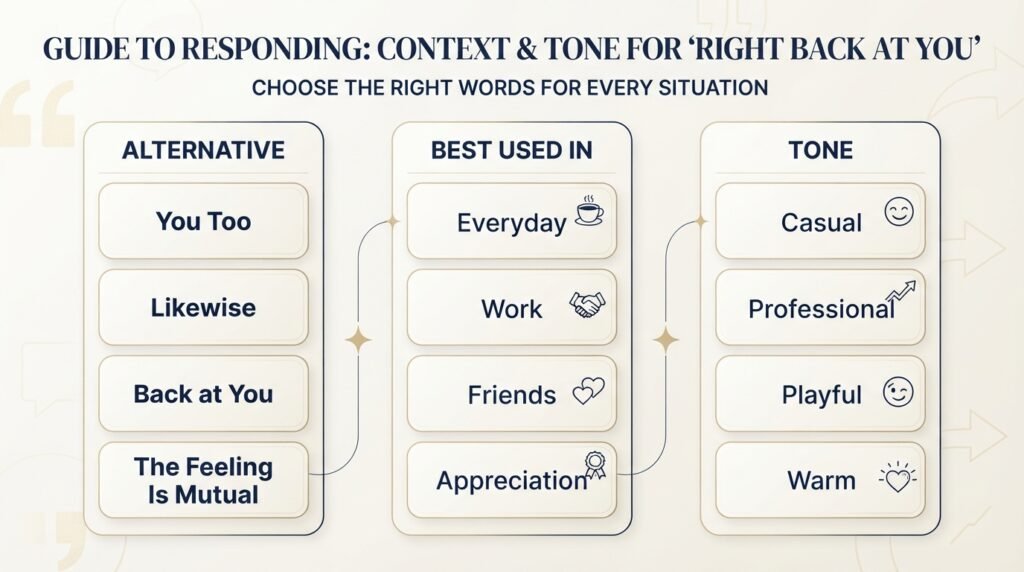
| Alternative | Best Used In | Tone |
| You too | Everyday conversations | Casual, friendly |
| Same to you | Wishes and greetings | Friendly, warm |
| Likewise | Work and polite conversations | Professional, polite |
| Back at you | Casual conversations | Casual, playful |
| The feeling is mutual | Shared appreciation | Warm, sincere |
| I feel the same way | Personal conversations | Warm, genuine |
| Same here | Informal conversations | Casual, relaxed |
| I could say the same about you | Returning compliments | Friendly, thoughtful |
| The same goes for you | General conversations | Polite, balanced |
| And the same to you | Greetings and wishes | Warm, polite |
Common Mistakes
1. Using a Casual Phrase in a Formal Email
Expressions like “back at you” or “same here” may sound too relaxed in professional communication. Choose “likewise” or “the same goes for you” when the setting requires a more polished tone.
2. Choosing Language That Sounds Too Formal
A phrase like “the feeling is mutual” can sound overly serious when someone simply says, “Have a great weekend.” Match the phrase to the level of the conversation.
3. Repeating the Same Response Every Time
Using “right back at you” in every conversation can become predictable. Mixing in natural alternatives makes your communication sound more spontaneous.
4. Ignoring the Context
Not every alternative works for every type of statement. “Same here” works for shared opinions, while “same to you” works better for returning a wish.
5. Sounding Insincere
A returned compliment should feel genuine. If you do not actually share the same feeling, avoid using phrases that suggest a stronger connection than you mean.
Frequently Asked Questions
What is another way to say “right back at you”?
Common alternatives include “you too,” “same to you,” “likewise,” “the feeling is mutual,” and “back at you.” The best option depends on what the other person said and how formal or casual the conversation is. “You too” is usually the easiest choice for everyday situations.
Is “right back at you” grammatically correct?
Yes, “right back at you” is grammatically acceptable as an informal expression. It is commonly used in spoken English and casual writing to return a compliment, wish, or positive statement. For formal communication, you may prefer alternatives such as “likewise” or “the same goes for you.”
What does “right back at you” mean in a compliment?
When used after a compliment, “right back at you” means that you are returning the same compliment. For example, if someone says, “You’re amazing,” responding with “Right back at you” means that you also think the other person is amazing.
Is “you too” the same as “right back at you”?
They are similar, but they are not always used in exactly the same situations. “You too” is especially common for returning wishes, such as “Have a nice day.” “Right back at you” is often used to return compliments, feelings, or playful remarks.
What is a professional way to say “right back at you”?
“Likewise” is one of the best professional alternatives. Other good choices include “the feeling is mutual,” “the same goes for you,” and “I could say the same about you.” These options sound respectful while still allowing you to respond warmly.
How do you say “right back at you” formally?
For a more formal response, try “likewise,” “the same to you,” or “the same goes for you.” The right choice depends on the original statement. “Likewise” is especially useful when you want a short, professional response without sounding cold.
What can I say instead of “right back at you” to a friend?
You can say “back at you,” “you too,” “same here,” or “I feel the same way.” These alternatives sound natural in friendly conversations. If you are responding to a compliment, “I could say the same about you” can make your answer feel especially genuine.
Is “the feeling is mutual” a good replacement for “right back at you”?
Yes, but it works best when someone expresses appreciation, affection, or a positive opinion about you. For example, if someone says they enjoy working with you, “the feeling is mutual” is an excellent response. It may sound too serious for a simple greeting or casual wish.
Conclusion
Finding another way to say right back at you can help you respond to compliments, wishes, and positive feelings in a more natural way. “You too” is perfect for simple everyday responses, while “same to you” adds a little more warmth. In professional settings, “likewise” and “the same goes for you” are usually better choices.
Choose the phrase that feels most natural, and your conversation will come across as warmer and more sincere. For more guidance on everyday English usage, explore understanding everyday English expressions.

Amara Reyes has taught English to adult learners for over eight years. She focuses on how phrases are actually used in everyday conversation, not just textbook definitions.