
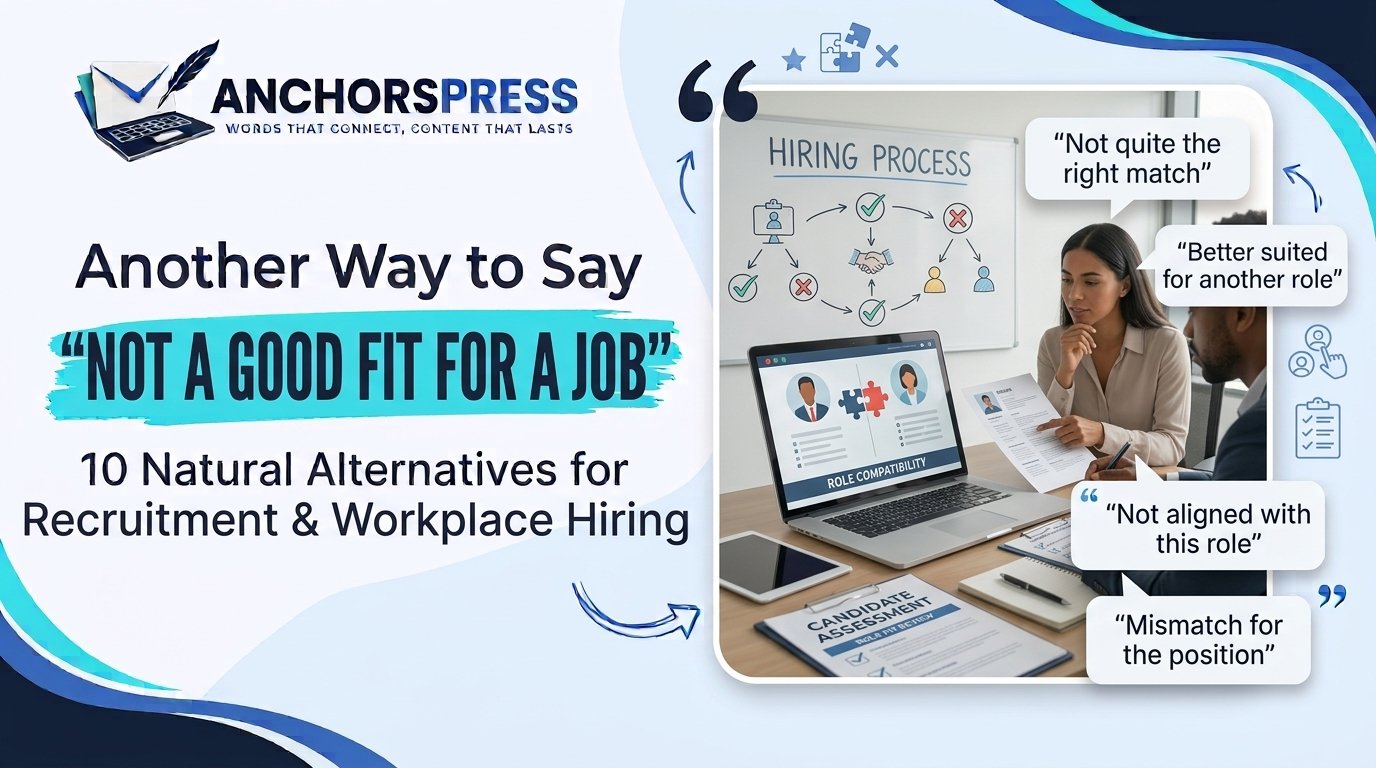
What Does “Another Way to Say Not a Good Fit for a Job” Mean?

The phrase “not a good fit for a job” means that a person’s skills, experience, qualifications, expectations, or working style do not closely match the requirements of a particular position.
It is commonly used during hiring, interviews, performance discussions, and career conversations. Because the phrase can sound personal or vague, people often look for more professional ways to communicate the same idea.
For example, a hiring manager might say that a candidate “is not the right fit for the role” instead of simply saying, “You are not a good fit.”
Why Use Other Ways to Say “Not a Good Fit for a Job”?
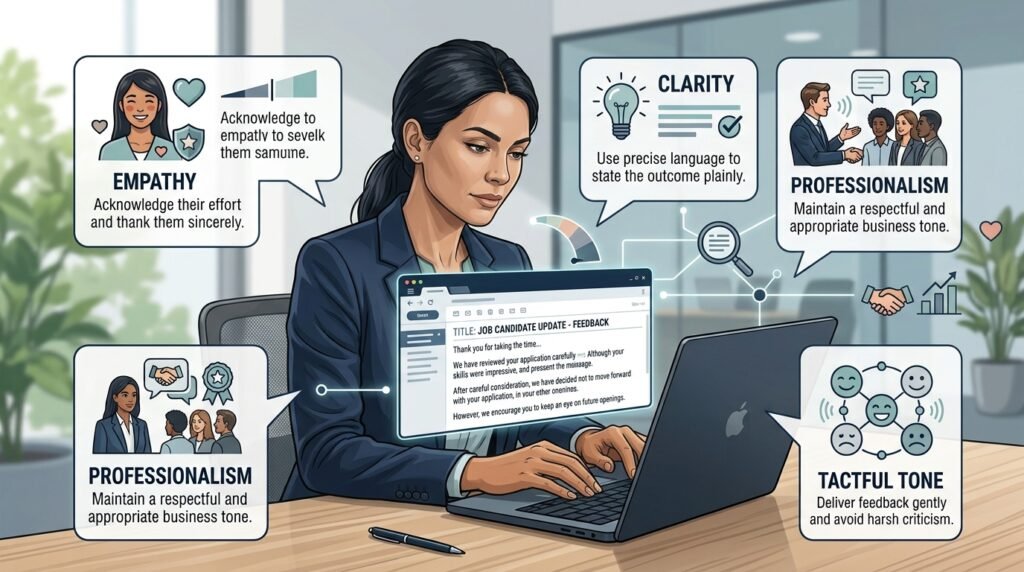
Using alternative wording can make professional communication more precise and respectful. The best phrase depends on whether you are writing a rejection email, giving feedback, discussing a career move, or explaining why a position does not match someone’s experience.
Other expressions can help you:
- Avoid sounding overly negative.
- Give clearer professional feedback.
- Match the tone to the situation.
- Focus on job requirements instead of personality.
- Communicate rejection more tactfully.
- Explain a mismatch without sounding insulting.
10 Best Other Ways to Say “Not a Good Fit for a Job”
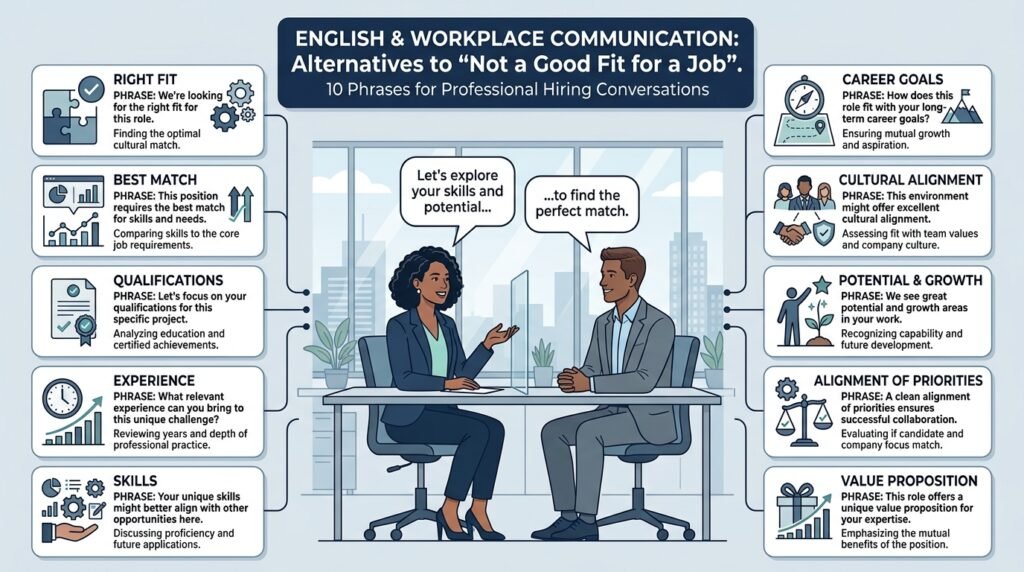
1. Not the Right Fit for the Role
Meaning
This is one of the most natural and widely used professional alternatives. It indicates that the candidate and position do not align closely enough without suggesting that the person lacks overall ability.
Best For
- Professional
- Polite
- Formal
Example 1
“After reviewing the candidates, we decided that this position is not the right fit for you at this time.”
Example 2
“Your experience is valuable, but this particular role may not be the right fit.”
Quick Tip
Use this when you want to communicate a hiring decision without sounding unnecessarily harsh.
2. Not Suited for the Position
Meaning
“Not suited for the position” suggests that a person’s current qualifications or experience do not match what the job requires. It is slightly more formal than “not a good fit.”
Best For
- Formal
- Professional
- Polite
Example 1
“Based on the requirements, we determined that the candidate is not suited for the position.”
Example 2
“Your background is impressive, but the role may not be suited to your current experience.”
Quick Tip
This phrase works particularly well in formal evaluations or written feedback.
3. Not the Best Match for the Job
Meaning
This phrase emphasizes comparison between the candidate and the specific requirements of the position. It can sound softer because it does not imply that the candidate is generally unqualified.
Best For
- Professional
- Friendly
- Polite
Example 1
“We appreciate your interest, but we found another applicant who is a closer match for the job.”
Example 2
“Your skills are strong, although this may not be the best match for your current career goals.”
Quick Tip
Choose this wording when several qualified candidates are competing for the same position.
4. The Role May Not Align With Your Qualifications
Meaning
This option focuses directly on qualifications rather than personal characteristics. It works especially well when a position requires specific technical skills, certifications, or experience.
Best For
- Formal
- Professional
- Polite
Example 1
“At this stage, the role may not align closely with your qualifications.”
Example 2
“The position requires specialized experience that does not currently align with your background.”
Quick Tip
Use this when you want your feedback to be specific and connected to measurable job requirements.
5. Your Experience Doesn’t Match the Role
Meaning
This phrase clearly explains that the candidate’s professional background differs from what the employer needs. It is direct but can remain respectful when delivered thoughtfully.
Best For
- Professional
- Formal
- Polite
Example 1
“Your experience doesn’t closely match the role we are looking to fill.”
Example 2
“The position requires extensive project management experience, which isn’t reflected in your current background.”
Quick Tip
Use this when experience is the main reason for the mismatch.
6. The Position Isn’t Aligned With Your Career Goals
Meaning
This wording shifts attention from rejection to career direction. It works well when someone may have the skills for a job but would probably be happier or more successful elsewhere.
Best For
- Professional
- Warm
- Friendly
Example 1
“After learning more about your goals, I don’t think this position is fully aligned with your career plans.”
Example 2
“This role offers a different career path from the direction you’ve described wanting to pursue.”
Quick Tip
This is a good choice when the issue is career direction rather than ability.
7. Your Skills May Be Better Suited to Another Role
Meaning
This phrase takes a constructive approach by suggesting that the person’s skills could be valuable somewhere else. It avoids making the rejection sound like a judgment of their abilities.
Best For
- Professional
- Warm
- Polite
Example 1
“Your communication skills may be better suited to another role within the organization.”
Example 2
“We believe your technical background could be better suited to a position with a stronger development focus.”
Quick Tip
Use this when you genuinely see another type of opportunity that could match the person’s strengths.
8. This Role Doesn’t Match Your Current Skill Set
Meaning
This expression focuses on the skills required today rather than making a permanent judgment about someone’s potential. It can be useful when the candidate may become qualified with additional training.
Best For
- Professional
- Formal
- Polite
Example 1
“This role doesn’t match your current skill set closely enough for what the team needs.”
Example 2
“The position calls for advanced analytics experience that isn’t part of your current skill set.”
Quick Tip
The word “current” makes the statement less absolute and leaves room for future development.
9. We’re Looking for a Different Background for This Position
Meaning
This is a tactful way to explain that the employer needs a different combination of experience or expertise. It places the emphasis on the company’s requirements rather than the applicant’s shortcomings.
Best For
- Professional
- Polite
- Formal
Example 1
“For this opening, we’re looking for a different background with more experience in enterprise sales.”
Example 2
“Your background is interesting, but we’re currently looking for a different set of industry experience.”
Quick Tip
This phrase works well in candidate communications because it avoids overly personal language.
10. This Opportunity May Not Be the Best Match
Meaning
“This opportunity may not be the best match” is gentle and flexible. It can refer to skills, experience, responsibilities, expectations, or career goals without identifying one specific weakness.
Best For
- Friendly
- Warm
- Polite
Example 1
“After discussing the responsibilities, we believe this opportunity may not be the best match for your goals.”
Example 2
“We appreciate your time and interest, but this opportunity may not be the best match at this stage.”
Quick Tip
Use this when you want to keep the message warm and professional while avoiding overly detailed feedback.
Comparison Table
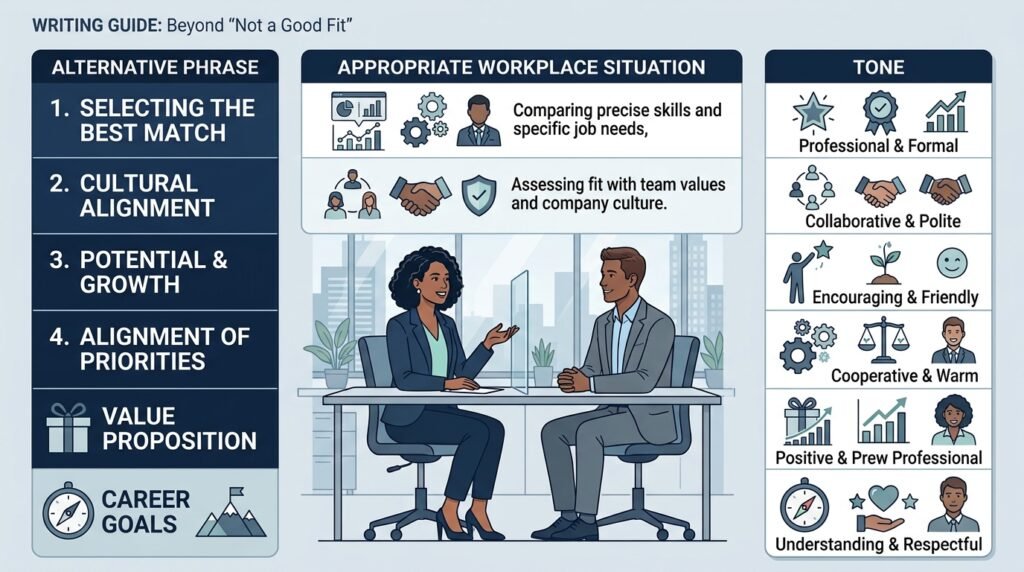
| Alternative | Best Used In | Tone |
| Not the right fit for the role | Hiring decisions | Professional, polite |
| Not suited for the position | Formal feedback | Formal, professional |
| Not the best match for the job | Candidate comparisons | Professional, friendly |
| The role may not align with your qualifications | Qualification-based feedback | Formal, tactful |
| Your experience doesn’t match the role | Experience-related feedback | Direct, professional |
| The position isn’t aligned with your career goals | Career discussions | Warm, supportive |
| Your skills may be better suited to another role | Internal opportunities | Warm, constructive |
| This role doesn’t match your current skill set | Skills assessments | Professional, clear |
| We’re looking for a different background for this position | Hiring communication | Polite, formal |
| This opportunity may not be the best match | General rejection | Warm, polite |
Common Mistakes
1. Using Casual Phrases in Professional Emails
Saying “this job isn’t really for you” can sound dismissive. Professional communication should use respectful language that explains the mismatch without belittling the candidate.
2. Choosing Overly Formal Language
Extremely formal wording can make a simple message sound cold or unnatural. Choose language that fits the relationship and communication channel.
3. Making the Rejection Personal
Avoid statements such as “You’re not good enough for this job.” Focus on the position’s requirements instead of attacking the person’s abilities.
4. Forgetting Context
A phrase suitable for an interview rejection may not work during a friendly career conversation. Consider who you are speaking to and why the role is not a match.
5. Sounding Insincere
Avoid adding unnecessary praise simply to soften bad news. A short, honest explanation is usually more respectful than exaggerated compliments followed by vague criticism.
Frequently Asked Questions
What is a professional way to say someone is not a good fit for a job?
A professional option is “not the right fit for the role.” You can also say that the position does not align with the person’s qualifications, experience, or career goals. These alternatives sound more respectful because they focus on the relationship between the candidate and the job rather than labeling the individual.
How do you politely say a candidate is not a good fit?
You can say, “We appreciate your interest, but we’ve decided to move forward with candidates whose experience more closely matches the requirements of the role.” This wording is polite, clear, and focused on job-related qualifications instead of making a negative personal judgment.
What is another way to say “not a good fit” professionally?
Some strong professional alternatives include “not the right fit for the role,” “not the best match for the position,” and “the role may not align with your qualifications.” The best choice depends on whether you want to emphasize skills, experience, career goals, or overall compatibility.
How do you say a job is not a good fit for you?
You could say, “I don’t think this position aligns with my current career goals,” or “I don’t believe this role is the best match for my skills and experience.” Both options communicate your decision professionally without criticizing the employer or the position.
Can you say “not suited for the position” in a job rejection?
Yes. “Not suited for the position” is grammatically correct and appropriate in formal contexts. However, it can sound somewhat direct. A softer alternative such as “not the right fit for the role” may feel more natural in a candidate-facing email.
What is a softer way to say someone isn’t qualified for a job?
Instead of saying someone is “unqualified,” you can say “the role requires experience that isn’t currently reflected in your background.” This approach identifies the gap without making a broad judgment about the person’s overall ability or future potential.
Is “not a good fit” rude in a job context?
Not necessarily. “Not a good fit” is common professional language, but its effect depends on how it is used. Without context, it can sound vague. Adding a job-related reason, such as skills, experience, or role requirements, can make the message clearer and more constructive.
What should you say instead of “you are not a good fit”?
Try “This role may not align closely with your current experience,” or “We are looking for a different background for this position.” These phrases keep the focus on the job’s requirements and make the conversation more respectful and professional.
Conclusion
Knowing another way to say not a good fit for a job can help you communicate hiring decisions, career choices, and professional feedback with greater clarity. The best phrase depends on what you want to emphasize.
Most importantly, keep the conversation respectful and job-focused. A thoughtful explanation can communicate a difficult decision without making the other person feel personally rejected. Learning how to provide professional feedback can also help make these conversations clearer and more constructive.

Amara Reyes has taught English to adult learners for over eight years. She focuses on how phrases are actually used in everyday conversation, not just textbook definitions.