

What Does “What Is Another Way to Say in My Opinion” Mean?

The phrase “in my opinion” introduces a personal belief, judgment, or viewpoint. It tells the reader or listener that the statement reflects your perspective rather than an established fact.
People commonly use it in conversations, essays, emails, reviews, discussions, and workplace communication. For example, you might say, “In my opinion, this is the best option.”
Although the phrase is correct and widely understood, repeating it too often can make your writing feel predictable. Using alternatives can make your language more natural and help you match the tone of a particular situation.
Why Use Other Ways to Say “In My Opinion”?
Using different expressions can make your communication more flexible and precise. You may also want an alternative because some situations call for a professional phrase, while others sound better with casual language.
Other expressions can help you:
- Avoid repeating the same phrase.
- Make your writing sound more natural.
- Match formal and informal situations.
- Communicate your viewpoint with the right level of confidence.
- Make professional emails and discussions more polished.
- Show whether you are sharing a belief, preference, or personal perspective.
10 Best Other Ways to Say “In My Opinion”
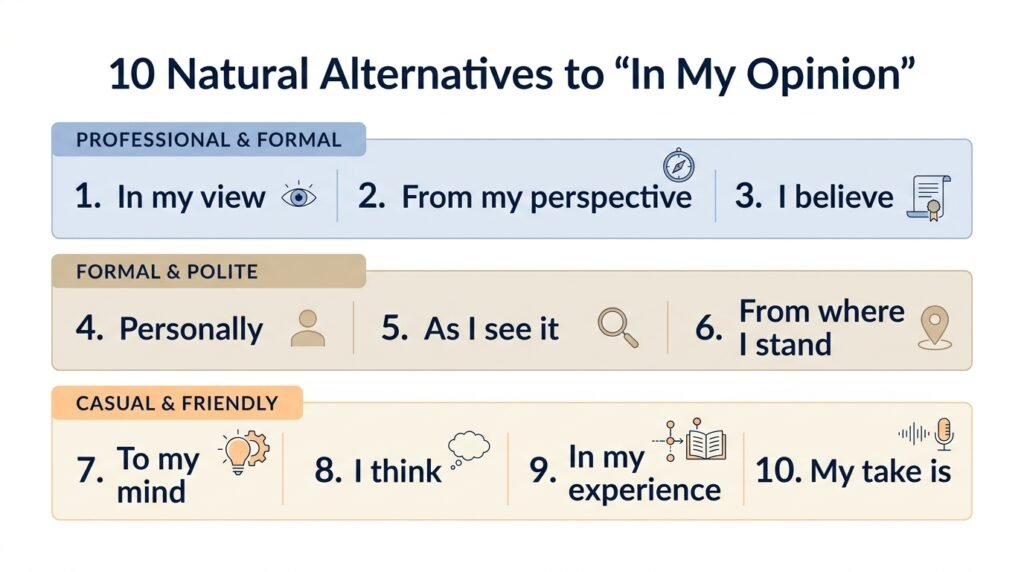
1. In My View
Meaning
“In my view” means that you are presenting your personal judgment or perspective. It has nearly the same meaning as “in my opinion,” but it often sounds slightly smoother and more concise.
Best For
- Professional
- Formal
- Polite
- Friendly
Example 1
In my view, the team should focus on improving customer support before launching another product.
Example 2
In my view, this design gives the website a cleaner and more professional appearance.
Quick Tip
Use “in my view” when you want a direct alternative that works well in both professional and everyday communication.
2. From My Perspective
Meaning
“From my perspective” emphasizes that your statement comes from your personal experience, position, or way of seeing a situation. It can sound thoughtful and professional.
Best For
- Professional
- Formal
- Polite
Example 1
From my perspective, the revised schedule gives everyone enough time to complete the project properly.
Example 2
From my perspective, working remotely has made it easier to manage my daily responsibilities.
Quick Tip
Choose this phrase when your opinion is shaped by your role, experience, or personal point of view.
3. I Believe
Meaning
“I believe” introduces a belief or judgment that you consider reasonable or likely to be true. It can sound more confident than simply saying “in my opinion.”
Best For
- Professional
- Formal
- Polite
Example 1
I believe this approach will give the company better results over the next year.
Example 2
I believe students learn more effectively when they can connect lessons to real-life examples.
Quick Tip
Use “I believe” when you want to express an opinion with confidence while still making it clear that it is your view.
4. Personally
Meaning
“Personally” highlights that something reflects your individual preference, feeling, or judgment. It is especially natural when discussing choices or preferences.
Best For
- Casual
- Friendly
- Warm
Example 1
Personally, I prefer the second restaurant because the atmosphere feels more relaxed.
Example 2
Personally, I would choose the simpler design because it is easier to navigate.
Quick Tip
“Personally” works best when your individual preference matters more than presenting a formal argument.
5. As I See It
Meaning
“As I see it” means “the way I understand or view the situation.” It has a conversational quality and can introduce an interpretation or judgment.
Best For
- Casual
- Friendly
- Polite
Example 1
As I see it, we have two realistic options if we want to finish the project on time.
Example 2
As I see it, the biggest advantage of this plan is its simplicity.
Quick Tip
Use this phrase when you want your opinion to sound natural and conversational rather than overly formal.
6. From Where I Stand
Meaning
“From where I stand” presents an opinion based on your position, experience, or understanding of a situation. It can sound confident without necessarily sounding aggressive.
Best For
- Professional
- Casual
- Polite
Example 1
From where I stand, the company made a reasonable decision given the available information.
Example 2
From where I stand, there is no reason to rush the decision before we review the final numbers.
Quick Tip
This expression is useful when your viewpoint comes from a particular role or position.
7. To My Mind
Meaning
“To my mind” means “in my opinion” or “as I understand it.” It has a more polished and slightly formal tone than many everyday alternatives.
Best For
- Formal
- Professional
- Polite
Example 1
To my mind, the proposal needs more evidence before it can be approved.
Example 2
To my mind, the strongest part of the presentation was the clear explanation of the research findings.
Quick Tip
Use “to my mind” sparingly in American English because it can sound more formal or literary than “in my view.”
8. I Think
Meaning
“I think” is one of the most common and natural ways to introduce a personal opinion. It is simple, flexible, and suitable for many everyday conversations.
Best For
- Casual
- Friendly
- Professional
Example 1
I think we should compare the two proposals before making a final decision.
Example 2
I think this is a better solution because it will save both time and money.
Quick Tip
When in doubt, use “I think.” It sounds natural in American English and rarely feels unnecessarily formal.
9. In My Experience
Meaning
“In my experience” connects your viewpoint to something you have personally observed, done, or encountered. It is useful when your opinion comes from practical experience.
Best For
- Professional
- Formal
- Polite
Example 1
In my experience, clear instructions prevent most misunderstandings during a large project.
Example 2
In my experience, customers respond better when businesses explain problems honestly and quickly.
Quick Tip
Use this expression when you have firsthand experience that supports the point you are making.
10. My Take Is
Meaning
“My take is” introduces your personal interpretation or conclusion about a topic. It is informal and contemporary, making it a good choice for relaxed discussions.
Best For
- Casual
- Friendly
- Warm
Example 1
My take is that the new policy could work if employees receive better training.
Example 2
My take is that the movie is worth watching, even though the ending feels rushed.
Quick Tip
Use “my take is” in conversations, informal articles, or discussions where a relaxed tone feels appropriate.
Comparison Table
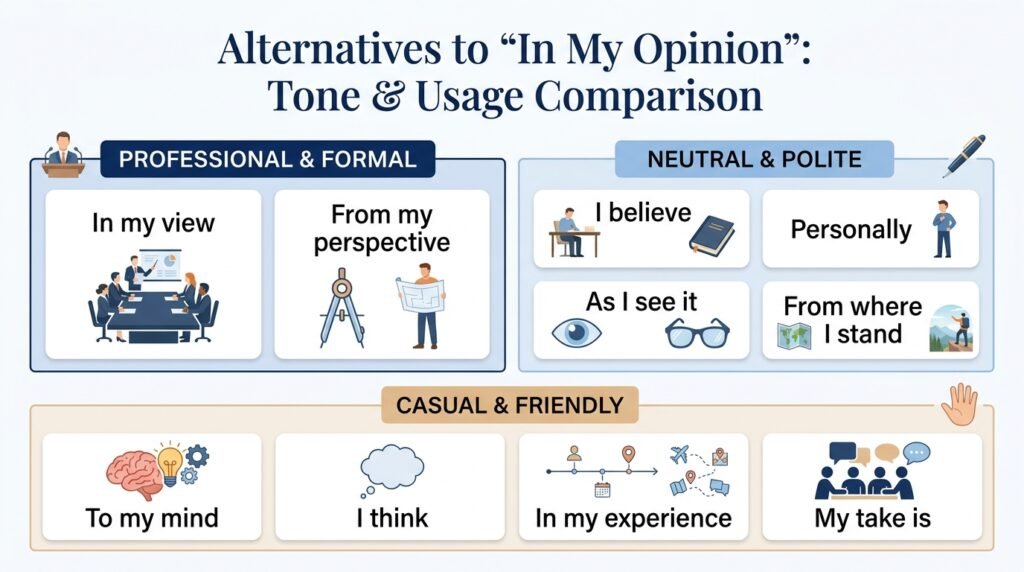
| Alternative | Best Used In | Tone |
| In my view | Professional, everyday writing | Neutral, polished |
| From my perspective | Workplace, formal discussions | Professional, thoughtful |
| I believe | Essays, business communication | Confident, professional |
| Personally | Conversations, preferences | Casual, personal |
| As I see it | Discussions, conversations | Conversational |
| From where I stand | Opinions based on position | Confident, direct |
| To my mind | Formal writing and discussion | Formal, polished |
| I think | Everyday speech and writing | Natural, flexible |
| In my experience | Advice and professional discussions | Practical, credible |
| My take is | Informal discussions | Casual, contemporary |
Common Mistakes
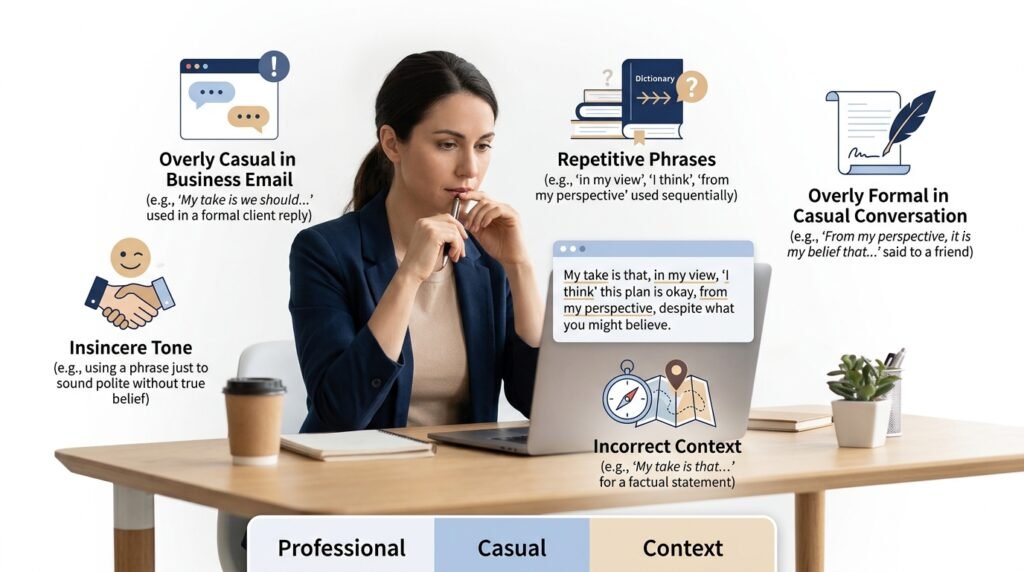
1. Using Casual Phrases in Professional Emails
Expressions such as “my take is” may sound too relaxed in a formal business email. When writing professionally, “from my perspective” or “in my view” may be a better fit.
2. Choosing Overly Formal Language
Not every situation requires sophisticated wording. Using “to my mind” in a casual conversation can sound unnatural when a simple “I think” would communicate the same idea.
3. Repeating the Same Phrase
Using “in my opinion” several times in one paragraph can make your writing repetitive. Vary your wording when the context allows it.
4. Forgetting Context
An expression that works in a conversation may not work equally well in an academic essay or workplace report. Always consider your audience and purpose before choosing an alternative.
5. Sounding Insincere
Avoid adding opinion phrases simply to make a statement sound softer or more sophisticated. Choose wording that genuinely reflects how strongly you feel about the subject.
Frequently Asked Questions

What is the most professional way to say “in my opinion”?
“From my perspective” and “in my view” are two strong professional alternatives. “From my perspective” works particularly well when your opinion comes from your experience or role, while “in my view” is concise and neutral. Both are appropriate for workplace emails, reports, meetings, and professional discussions.
What is a casual way to say “in my opinion”?
For casual conversations, “I think,” “personally,” and “as I see it” are natural choices. “I think” is probably the simplest option because Americans use it frequently in everyday speech. “Personally” works especially well when you are discussing your own preference or feeling.
Is “in my view” the same as “in my opinion”?
Yes. “In my view” and “in my opinion” generally communicate the same idea: you are giving your personal perspective rather than stating an objective fact. “In my view” is often shorter and can sound slightly more polished, especially in professional writing.
Can I use “I believe” instead of “in my opinion”?
Yes, but the two expressions can have slightly different effects. “I believe” can sound more confident because it presents a belief directly. “In my opinion” explicitly labels the statement as a personal opinion. Choose based on how strongly you want to express your position.
What is another way to say “in my opinion” in an essay?
For an essay, “in my view,” “I believe,” and “from my perspective” can work well. However, strong academic writing does not need an opinion phrase before every claim. When evidence supports your argument, stating the evidence directly can often make the writing clearer and more authoritative.
Is “personally” a good synonym for “in my opinion”?
Yes. “Personally” can introduce a personal preference or judgment, but it is usually more conversational. For example, “Personally, I prefer the first option” clearly shows that the statement reflects your individual preference rather than an objective conclusion.
What is the difference between “from my perspective” and “in my opinion”?
“From my perspective” often suggests that your opinion is influenced by your experience, position, or circumstances. “In my opinion” is broader and simply identifies a personal judgment. For example, an employee might say, “From my perspective, the new schedule creates unnecessary delays.”
Can I use “as I see it” in professional communication?
Yes, but it depends on the setting. “As I see it” is professional enough for many meetings and discussions, although it has a more conversational tone than “from my perspective.” For highly formal documents, “in my view” or “from my perspective” may sound more appropriate.
Conclusion
Knowing what is another way to say in my opinion can help you make your English more natural, precise, and flexible. The best alternative depends on your audience and the situation.
When the wording matches the context, your communication becomes clearer and more effective. For more guidance on ways to express an opinion in English, Cambridge Dictionary provides useful grammar examples and explanations.

Daniel Cho writes about professional communication, drawing on years spent training teams on clear, confident workplace writing — from emails to performance reviews.