

What Does “Another Way to Say Benefit of the Doubt” Mean?

“Benefit of the doubt” means choosing to believe someone is honest or has good intentions when you do not have enough information to know for certain. For example, if a friend arrives late but has a reasonable explanation, you might give them the benefit of the doubt.
People often look for another way to say “benefit of the doubt” because the original phrase can feel repetitive. Depending on the situation, you may want a phrase that sounds more professional, forgiving, supportive, or conversational.
The expression is commonly used when discussing mistakes, misunderstandings, disagreements, delayed responses, or situations where someone’s actions could have more than one explanation.
Why Use Other Ways to Say “Benefit of the Doubt”?
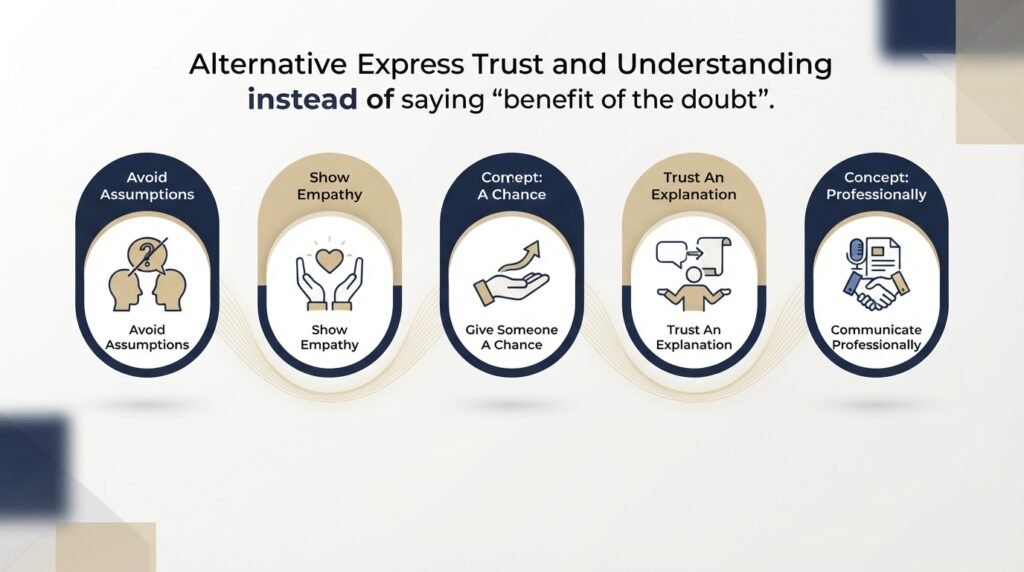
Using different expressions can make your English more precise and natural. Instead of repeating the same idiom, you can choose wording that shows exactly what you mean.
Other phrases can help you:
- Avoid repetitive language.
- Sound more natural in conversation.
- Communicate fairness and understanding.
- Match professional or casual situations.
- Show trust without sounding overly formal.
- Express forgiveness or patience more clearly.
10 Best Other Ways to Say “Benefit of the Doubt”
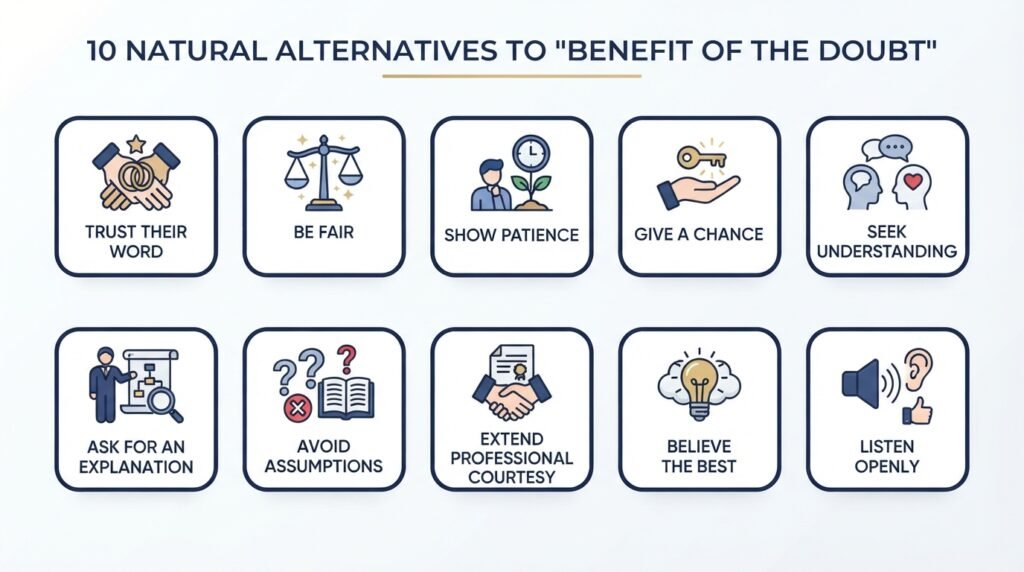
1. Assume Good Intentions
Meaning
“Assume good intentions” means choosing to believe that someone meant well rather than immediately judging their actions negatively. It is especially useful when someone’s words or behavior could easily be misunderstood.
Best For
- Professional
- Formal
- Friendly
- Polite
Example 1
Before criticizing the manager, let’s assume good intentions and ask what happened.
Example 2
I decided to assume good intentions because her comment may not have been meant to offend anyone.
Quick Tip
Use this phrase when you want to emphasize someone’s motives rather than whether their action was correct.
2. Give Someone a Chance
Meaning
“Give someone a chance” means allowing a person an opportunity to explain themselves, prove their intentions, or correct a mistake. It sounds more encouraging than the original phrase.
Best For
- Casual
- Friendly
- Warm
- Polite
Example 1
He made one mistake, so I’m willing to give him a chance to fix it.
Example 2
Give her a chance before deciding that she cannot handle the responsibility.
Quick Tip
This is a good option when you want to focus on opportunity rather than trust.
3. Trust Their Explanation
Meaning
“Trust their explanation” means accepting someone’s account of what happened instead of assuming they are being dishonest. It works particularly well when there has been a misunderstanding.
Best For
- Professional
- Formal
- Polite
Example 1
I trust his explanation because the timeline supports what he told us.
Example 2
She chose to trust my explanation after I showed her the original message.
Quick Tip
Choose this phrase when the person has already provided a specific reason or explanation.
4. Take Them at Their Word
Meaning
“To take someone at their word” means believing what someone has said without demanding additional proof. It suggests that you are willing to trust their statement.
Best For
- Professional
- Formal
- Polite
Example 1
He promised to send the revised contract tomorrow, so I’ll take him at his word.
Example 2
The client said the payment was already processed, and we decided to take her at her word.
Quick Tip
This expression is best when someone has made a clear statement, promise, or commitment.
5. Give Them the Benefit of a Doubt
Meaning
“Give them the benefit of a doubt” is a variation of the familiar expression that puts the focus directly on the person involved. It means choosing not to assume the worst when the facts are unclear.
Best For
- Casual
- Friendly
- Polite
Example 1
I don’t know why he missed the meeting, so I’ll give him the benefit of a doubt.
Example 2
Let’s give the new employee the benefit of a doubt while she learns the process.
Quick Tip
This version is useful when you want to mention the person directly rather than discuss the concept in general.
6. Give Them a Fair Chance
Meaning
“Give them a fair chance” means judging someone fairly instead of forming an opinion too quickly. It often suggests patience and a willingness to let someone demonstrate what they can do.
Best For
- Professional
- Friendly
- Warm
- Polite
Example 1
The candidate has limited experience, but we should give him a fair chance.
Example 2
Don’t judge the project after one rough draft; give the team a fair chance to improve it.
Quick Tip
Use this phrase when the issue involves someone’s opportunity to prove themselves.
7. Be Understanding
Meaning
“To be understanding” means showing patience and sympathy toward someone’s situation. Unlike “benefit of the doubt,” it focuses more on empathy than belief.
Best For
- Professional
- Friendly
- Warm
- Polite
Example 1
Please be understanding if she needs extra time to complete the assignment.
Example 2
My supervisor was understanding when I explained why I needed to leave early.
Quick Tip
Use this alternative when compassion is more important than deciding whether someone’s story is completely true.
8. Give Them a Pass
Meaning
“Give someone a pass” is a casual expression meaning to overlook a mistake or decide not to criticize someone for it. It usually suggests that the mistake is minor or understandable.
Best For
- Casual
- Friendly
Example 1
I’ll give him a pass this time because he’s dealing with a lot at work.
Example 2
She forgot to call, but I’ll give her a pass because she had an emergency.
Quick Tip
Avoid this phrase in formal business writing because it has a distinctly conversational tone.
9. Don’t Jump to Conclusions
Meaning
“Don’t jump to conclusions” means avoiding a negative judgment before you have enough information. It encourages people to wait for the facts before deciding what happened.
Best For
- Professional
- Casual
- Friendly
- Polite
Example 1
Don’t jump to conclusions just because the customer hasn’t responded yet.
Example 2
We shouldn’t jump to conclusions until we hear both sides of the story.
Quick Tip
This phrase works especially well when advising someone to remain neutral during an uncertain situation.
10. Give Them the Benefit of Trust
Meaning
“Give them the benefit of trust” can express the idea of choosing to trust someone despite uncertainty. However, it is less idiomatic than “give them the benefit of the doubt,” so use it carefully.
Best For
- Friendly
- Warm
- Polite
Example 1
I decided to give her the benefit of trust after hearing her side of the story.
Example 2
When there is no evidence of dishonesty, giving people the benefit of trust can prevent unnecessary conflict.
Quick Tip
For natural American English, “assume good intentions” or “give them the benefit of the doubt” will usually sound more idiomatic.
Comparison Table

| Alternative | Best Used In | Tone |
| Assume good intentions | Work, relationships | Understanding |
| Give someone a chance | Personal, everyday situations | Encouraging |
| Trust their explanation | Work, disagreements | Professional |
| Take them at their word | Promises, commitments | Trusting |
| Give them the benefit of a doubt | Everyday conversation | Neutral |
| Give them a fair chance | Work, evaluations | Fair |
| Be understanding | Personal, workplace | Empathetic |
| Give them a pass | Casual conversations | Relaxed |
| Don’t jump to conclusions | Disagreements, uncertainty | Cautious |
| Give them the benefit of trust | Personal situations | Warm |
Common Mistakes
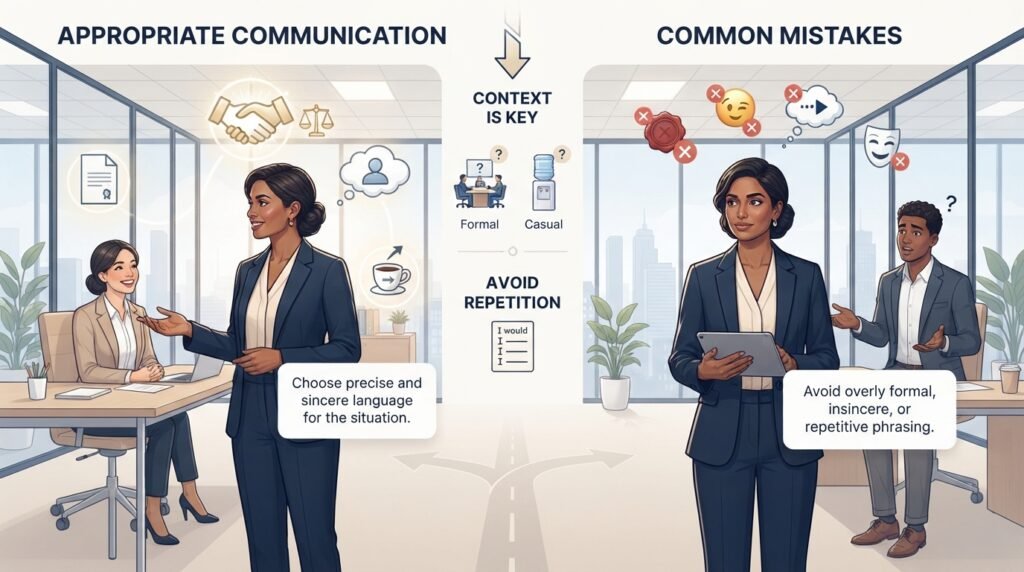
1. Using Casual Phrases in Professional Emails
Expressions such as “give them a pass” may sound too informal in a business email. Choose “assume good intentions” or “trust their explanation” when writing professionally.
2. Choosing Overly Formal Language
Not every situation requires sophisticated wording. In a conversation with a friend, a simple phrase such as “give them a chance” may sound more natural.
3. Repeating the Same Phrase
Using “benefit of the doubt” several times in one paragraph can make your writing feel repetitive. Switch to a suitable alternative when the meaning remains clear.
4. Forgetting Context
Not every synonym has exactly the same meaning. “Be understanding” emphasizes empathy, while “take them at their word” emphasizes trust in what someone said.
5. Sounding Insincere
Using a phrase about trust while your surrounding language sounds judgmental can create a mixed message. Make sure your wording matches the attitude you actually want to communicate.
Frequently Asked Questions
What is another way to say “benefit of the doubt”?
Some natural alternatives include “assume good intentions,” “give someone a chance,” “trust their explanation,” “take them at their word,” and “don’t jump to conclusions.” The best choice depends on your meaning. If you want to emphasize kindness, “be understanding” works well, while “trust their explanation” is better for a specific disagreement.
What is a professional way to say “benefit of the doubt”?
“Assume good intentions” is one of the strongest professional alternatives. You can also say “trust their explanation” or “avoid making assumptions.” These phrases work well in workplace conversations because they sound respectful and neutral without being overly casual.
What is a polite way to say “benefit of the doubt”?
“Assume good intentions” and “give them a fair chance” are both polite choices. They communicate that you do not want to judge someone too quickly. “Be understanding” is another good option when you want to emphasize patience and empathy.
What is a synonym for giving someone the benefit of the doubt?
Depending on the context, you can say “assume good intentions,” “trust their explanation,” “take them at their word,” or “give them a fair chance.” These expressions are related but not identical, so choose the one that best describes the kind of trust or patience you want to show.
How do you say “give someone the benefit of the doubt” in a sentence?
You could say, “I don’t know why Sarah missed the deadline, so I’ll give her the benefit of the doubt.” Another natural option is, “Let’s assume good intentions and find out what happened before we criticize her.” Both sentences show that you are avoiding an immediate negative judgment.
Is “give them a chance” the same as “benefit of the doubt”?
They are similar but not exactly the same. “Give them a chance” usually means allowing someone an opportunity to prove themselves or correct something. “Give them the benefit of the doubt” specifically means choosing to believe a positive explanation when the facts are uncertain.
What is a casual way to say “benefit of the doubt”?
In casual American English, you can say “give them a chance,” “give them a pass,” or “don’t jump to conclusions.” “Give them a pass” is especially informal and usually means overlooking a minor mistake rather than deciding whether someone’s explanation is true.
Can I use “assume good intentions” at work?
Yes. “Assume good intentions” is particularly useful in workplace communication because it encourages people to consider positive motives before making judgments. For example, you might say, “Let’s assume good intentions and ask for clarification before responding.” This keeps the conversation respectful and constructive.
Conclusion
Knowing another way to say “benefit of the doubt” gives you more flexibility when you want to express trust, patience, fairness, or understanding. “Assume good intentions” is a strong choice for professional communication, while “give someone a chance” feels more friendly and encouraging.
The key is to match the phrase to your meaning and audience. Instead of searching for a perfect synonym, choose the expression that communicates the exact kind of trust or fairness you want to show. For a clearer understanding of the original expression, see the meaning of “benefit of the doubt”.

Daniel Cho writes about professional communication, drawing on years spent training teams on clear, confident workplace writing — from emails to performance reviews.